About Crocodylus johnsoni Krefft, 1873
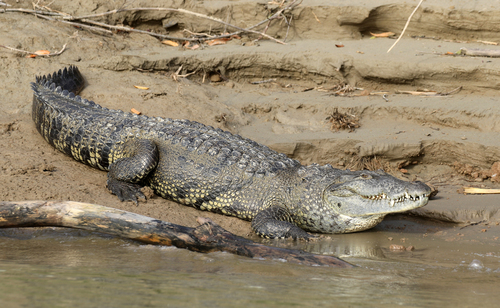
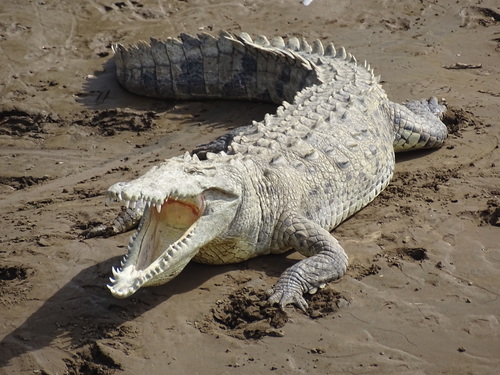
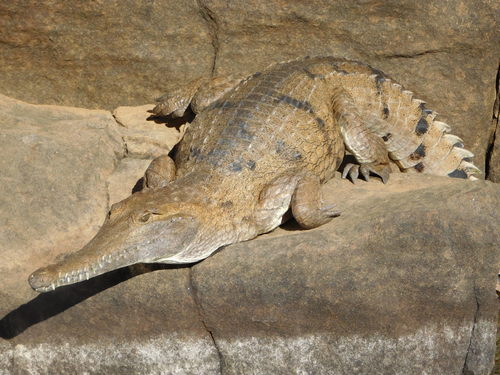
The freshwater crocodile (Crocodylus johnsoni Krefft, 1873) is a relatively small crocodilian species. Dominant males typically reach a total length of 2.3–3.0 m (7.5–9.8 ft), though 4 metre long specimens have been reported, with a small number of confirmed 4-metre (13-foot) individuals recorded in areas like Lake Argyle and Katherine Gorge. Females reach a maximum total length of 2.1 m (6.9 ft). Males commonly weigh around 70 kg (150 lb), while large males can weigh 100 kg (220 lb) or more; females typically weigh around 40 kg (88 lb). This species is shy, and has a more slender snout and slightly smaller teeth than the dangerous saltwater crocodile. Its body is light brown with darker bands across the body and tail, and these bands are usually broken up near the neck. Some individuals have clear bands or speckling on their snout. Its body scales are relatively large, with wide, closely connected armored plates on the back. The flanks and outer sides of the legs are covered in rounded, pebbly scales. Freshwater crocodiles are native to Western Australia, Queensland, and the Northern Territory of Australia. Their main habitats are freshwater wetlands, billabongs, rivers, and creeks. This species can live in areas that saltwater crocodiles cannot occupy, including regions above the escarpment in Kakadu National Park, and very arid, rocky habitats such as Katherine Gorge, where they are common and relatively safe from saltwater crocodiles during the dry season. Even so, they are also regularly found in low-lying billabongs, living alongside saltwater crocodiles near the tidal reaches of rivers. In May 2013, a freshwater crocodile was sighted in a river near the desert town of Birdsville, hundreds of kilometers south of the species' normal range. A local ranger suggested that multi-year flooding may have washed the animal south, or it may have been dumped there as a juvenile. A population of freshwater crocodiles has been repeatedly sighted for decades in the Ross River that runs through Townsville, and the leading theory is that frequent heavy flooding in the area washed multiple individuals into the Ross River Catchment. Freshwater crocodiles lay their eggs in nests dug as holes during the Australian dry season, usually in August. The eggs hatch at the start of the wet season, which falls in November or December. Adult crocodiles do not defend their nests while the eggs incubate. Between one and five days before hatching, developing young begin calling from inside their eggs. This calling triggers and synchronizes hatching among sibling eggs, and stimulates adult crocodiles to open the nest. It is unknown whether the adult that opens the nest is always the female that laid the eggs. When the young emerge from the nest, the adult carries them to the water one by one, holding them in the tip of its mouth. Adults may also help young break through their eggshells by chewing or manipulating the eggs in their mouth.