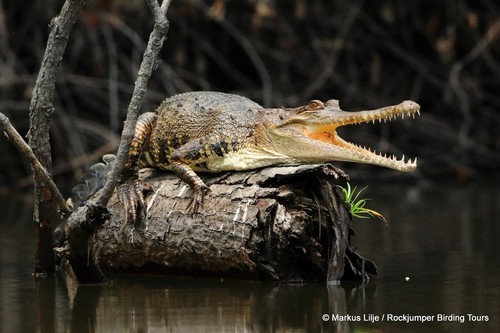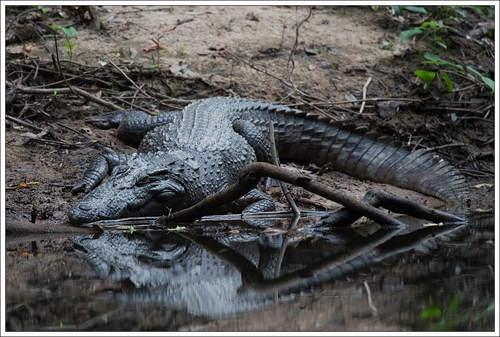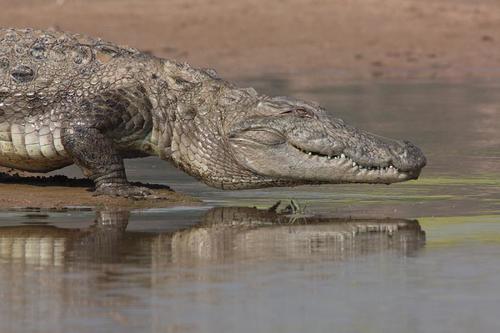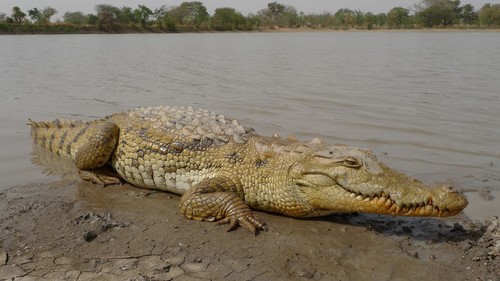
About Crocodylus acutus (Cuvier, 1807)
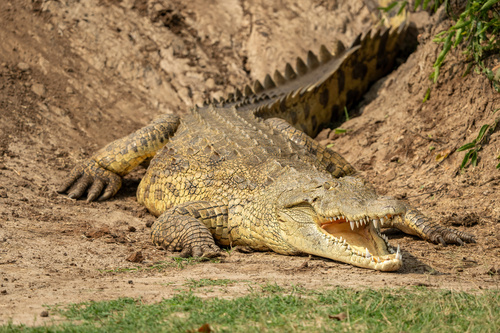
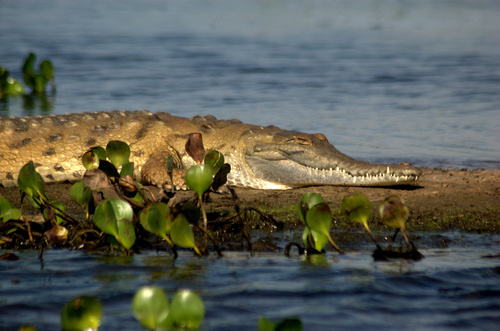
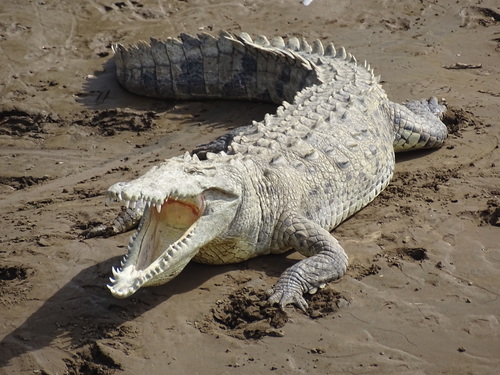
Characteristics: The American crocodile (Crocodylus acutus, Cuvier 1807) is a highly fecund species with an average clutch size of 38 eggs; after age 15, fecundity increases by over 20%. It has a high adult survival rate and long lifespan. Like all true crocodilians, it is a quadruped with short, stocky legs, a long powerful tail, and a scaly hide marked by rows of ossified scutes running down its back and tail. Because this species prefers to live in saline environments, these scutes often host epibionts including ticks, leeches, barnacles, and even sea anemones. Each individual can be uniquely identified by its dorsal scute pattern. It has an elongated snout and a strong pair of jaws; a 3.2-metre (10 ft 6 in), 164-kilogram (362 lb) specimen was recorded with a bite force of 4,355 N (979 lbf). Its eyes have protective nictitating membranes, paired with lacrimal glands that produce tears. Its nostrils, eyes, and ears are all situated on the top of its head, allowing the rest of the body to stay concealed underwater when preparing surprise attacks, and camouflage further aids its hunting. Compared to other related species, its snout is longer and narrower than that of the American alligator, but on average broader than that of the Orinoco crocodile; it is also paler and more grayish than the dark-hued American alligator. Adults have uniform grayish-green coloration with white or yellow undersides, while juveniles have dark cross-banding on their tail and back. This species normally crawls on its belly, but can also perform a "high walk". Larger specimens can charge at speeds close to 16 km/h (10 mph). When swimming, it can reach up to 32 km/h (20 mph) by moving its body and tail in a sinuous motion, but cannot sustain this top speed. The American crocodile is sometimes confused with Morelet's crocodile, a smaller species native to Mexico. Distribution and habitat: The American crocodile is the most widespread of the four extant crocodile species native to the Americas. It is saltwater-tolerant, which has allowed it to colonize numerous Caribbean islands and some coastal Pacific islands, making it the most widely distributed crocodile species in the New World. It inhabits a range of water bodies including mangrove swamps, river mouths, fresh water, and salt lakes, and can even be found at sea. Its distribution covers southern Florida, the Greater Antilles (excluding Puerto Rico and Isla de la Juventud, where it is replaced by the introduced spectacled caiman), Martinique, southern Mexico including the Yucatán Peninsula, Central America, and the South American countries of Colombia, Peru, Venezuela including Margarita Island, and Ecuador. It is especially abundant in Costa Rica. Within its range, the American crocodile coexists with the American alligator in Florida, and with the spectacled caiman in Central America. The only other crocodile species found in its range are Morelet's crocodile, the critically endangered Cuban crocodile, and the Orinoco crocodile. Recent morphological and genetic analyses have confirmed that American crocodiles in the Yucatan hybridize with Cuban crocodiles. Reproduction: American crocodiles breed in late fall or early winter, with drawn-out mating ceremonies where males emit low-frequency bellows to attract females. Body size, rather than age, determines reproductive capability; females reach sexual maturity at a length of about 2.8 m (9 ft 2 in). In February or March, gravid females build nests from sand, mud, and dead vegetation along the water's edge. Nests are usually mounds built on well-drained beaches or abandoned canal levees. Nest location is critical, as correct vegetation coverage keeps egg development within a narrow temperature range. Since crocodilian sex determination is temperature-dependent, small temperature deviations can result in entirely male or entirely female clutches, which can harm population health. About one month after nest building, when it is time to lay eggs, the female digs a wide diagonal hole into the side of the nest and lays between 30 to 70 eggs, with the number varying by her size. Females will maintain and reuse these holes for many years. After laying, the female may either cover the eggs with debris or leave them uncovered. The white, elongated eggs are 8 cm (3 in) long and 5 cm (2 in) wide, with numerous pores across their brittle shells. During the 75- to 80-day incubation period, parents guard the nest, and often stay in a nearby hole dug into the riverbank. Females are particularly known to guard nests ferociously. Even with these precautions, American crocodile eggs are still preyed on by a range of animals: raccoons in Florida, Belize and Costa Rica (arguably the most impactful natural predator of crocodilian nests in the Americas), white-nosed coatis in Costa Rica, foxes, skunks from the Conepatus, Mephitis and Spilogale genera in Mexico, other scavenging mammals including coyotes in Mexico and American black bears in southern Florida, red imported fire ants in Florida, crabs including Atlantic blue crabs in Florida and great land crabs in Mexico, and vultures including turkey vultures in Florida and black vultures in Panama. In Panama, green iguanas have been observed occasionally digging up and preying on American crocodile eggs, though in several cases the mother caught and ate the iguanas. Crocodilian eggs are somewhat brittle, but softer than bird eggs. Despite noticeable nest guarding during incubation, American crocodiles provide very little guarding for young after they hatch. This species lives mostly in tropical areas with distinct rainy seasons, and young hatch around the time of the first summer rains (July–August), following the preceding dry season and before the local water bodies flood. At this developmental stage, mother American crocodiles exhibit a unique mode of parental care. When hatching begins, young American crocodiles are at their most vulnerable to predation, and instinctively call out with soft, grunt-like croaks. These sounds trigger the female to approach the nest, uncover the eggs if they are covered, help the hatchlings escape their shells, scoop them up into her mouth, and carry them to the nearest water source. Newly hatched American crocodiles are 24 to 27 cm (9+1⁄2 to 10+1⁄2 in) long, and have been reported to actively hunt prey within a few days of hatching. It is not uncommon for a mother to care for her young for several weeks after hatching, remaining responsive to their calls and continuing to provide transport. Around five weeks after hatching, the young American crocodiles disband to live independently. On average, only 16% of hatchlings survive to adulthood; most are killed by multiple types of predators including raptorial birds, other reptiles, and large fish, such as roadside hawks and laughing falcons in Mexico, barred catfish in Colombia, Atlantic tarpons and common snook and lemon sharks in Florida, boa constrictors in Belize, black spiny-tailed iguanas in Costa Rica, and spectacled caimans in Venezuela. Surviving individuals grow rapidly, feeding on insects, fish and frogs. Some young American crocodiles also engage in cannibalism. In Florida, young American crocodiles may be eaten by invasive snakes of various growth stages, including Burmese pythons, reticulated pythons, Southern African rock pythons, Central African rock pythons, boa constrictors, yellow anacondas, Bolivian anacondas, dark-spotted anacondas, and green anacondas.