About Crithagra flaviventris (J.F.Gmelin, 1789)
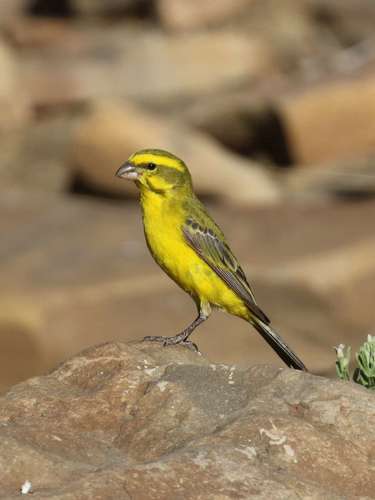
This species, commonly known as the yellow canary, has the scientific name Crithagra flaviventris (J.F.Gmelin, 1789). Yellow canaries typically measure 10 cm in length. Among adult males, plumage colour varies across their range: in the northwest, males are almost uniformly yellow, while in the southeast they have streaked, olive-coloured backs. All adult males have yellow underparts, rumps, and tail sides. Females have grey-brown upperparts, black wings with yellow flight feathers, and a pale supercilium. Their underparts are white with brown streaking. Juveniles resemble females, but have heavier streaking on their plumage. This species can be easily told apart from the yellow-fronted canary because it has no black facial markings. Its bill is also less heavy than the bills of other similar African Crithagra species. The brimstone canary, which shares an overlapping range with this species, is commonly confused with the yellow canary. The yellow canary inhabits karoo, and coastal or mountain valley scrub. It builds a compact cup-shaped nest within scrub vegetation. It is a common, gregarious seedeating bird. Its call is described as chissick or cheree, and its song is a warbled zee-zeree-chereeo.