About Crithagra citrinipectus (Clancey & Lawson, 1960)
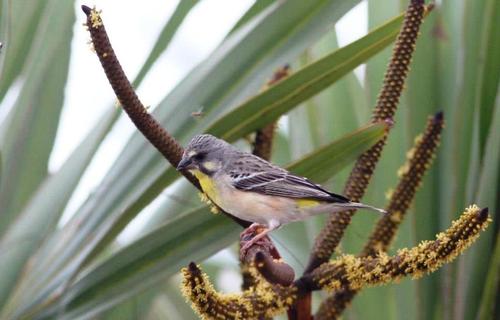
Description: Despite what the common name lemon-breasted canary suggests, not all individuals of this species have a yellow throat and chest. The species is easy to tell apart by sex, as only males have the characteristic yellow feathers on the breast. Females have mostly cream and brown plumage, with less distinct head markings. Both sexes do share two consistent traits: a noticeably yellow rump around the tail feathers, and a bicolored beak where the upper mandible is darker brown or black than the lower mandible. Males additionally have white and yellow cheek patches, and two small yellow and white spots above their beak. Nestlings of this species have yellow edges along their beaks. No subspecies are formally recognized, though small differences exist between populations from different regions. Range and distribution: This finch species occurs locally in Malawi, Zimbabwe, Mozambique, Zululand, South Africa, and Zambia. Though it has a restricted geographical range and an overall declining population, it is currently classified as a species of least concern on the IUCN Red List. Its total population size is not confirmed, but it is well above the threshold for vulnerable status, which requires fewer than 10,000 mature individuals. This species occupies and breeds across an area of 49,800 square kilometers. Habitat and ecology: The lemon-breasted canary lives in southeastern Africa, far south of the equator, and sometimes shares its range with Serinus mozambicus, commonly called the greensinger. It inhabits mostly dry areas, including grasslands with scattered low vegetation and the edges of wooded areas. It prefers to build its nests in specific palm species, using palm brown fibers for the outer nest structure, and lines the nest interior with softer materials.