About Criorhina berberina (Fabricius, 1805)
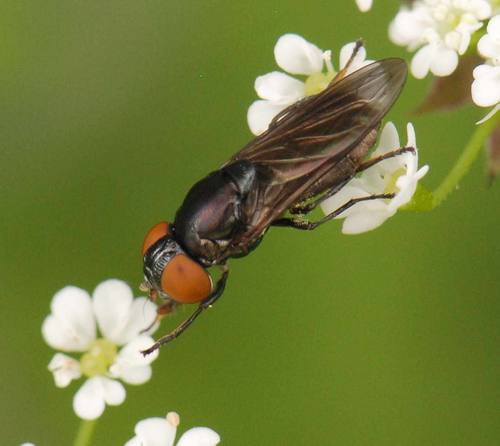
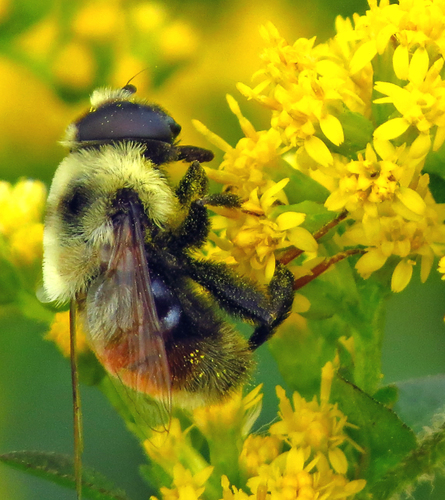
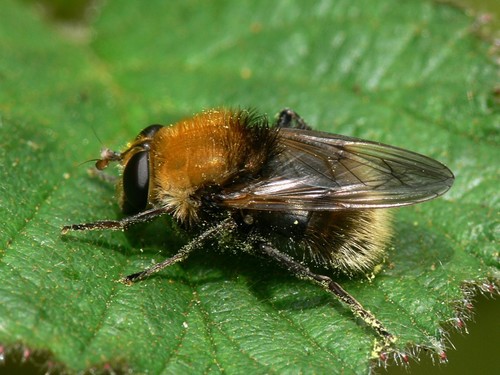
Criorhina berberina (Fabricius, 1805) is a species of hoverfly. This species is distributed across the Palaearctic region, ranging from Fennoscandia south to Iberia and Italy, and from Ireland eastward through Europe into Turkey and European Russia. C. berberina is a bumblebee mimic. Its body is covered in uniformly long, dense pubescence that obscures the base body color. There are two distinct forms of the species: the typical berberina form, which has pubescence that is more or less extensively blackish, and berberina var. oxyacanthae Meigen, which has entirely yellow or tawny pubescence.
Criorhina can be distinguished from other bumblebee-mimicking hoverfly genera — Mallota, Arctophila, Pocota, and Brachypalpus — by the structure of its antennae. In Criorhina, the first antennal segments are thin and form a stalk, while the third segment is shorter than it is wide. Unlike the genera Pocota and Brachypalpus, the face of Criorhina projects downwards.
Larvae of C. berberina live in association with rotting deciduous wood. Illustrations of the larva are provided by Hartley (1961) and Rotheray (1993). Adult C. berberina are arboreal, and occur in most types of coniferous and deciduous forests that contain overmature trees. Adults visit flowers to feed, and the flowers they visit include white umbellifers, Allium ursinum, Cornus sanguinea, Crataegus, Euonymus, Filipendula, Frangula alnus, Hypericum, Lonicera xylosteum, Photinia, Ranunculus, Rhamnus catharticus, Rhododendron, Rosa, Rubus idaeus, Salix, Sorbus, Taraxacum, and Viburnum opulus. The flight period of adult C. berberina runs from May to July. This species is used as a bioindicator.