About Crinodendron hookerianum Gay
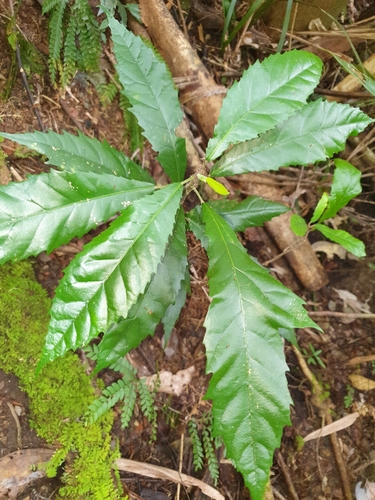
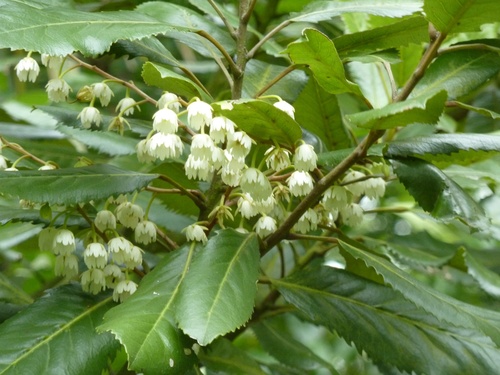
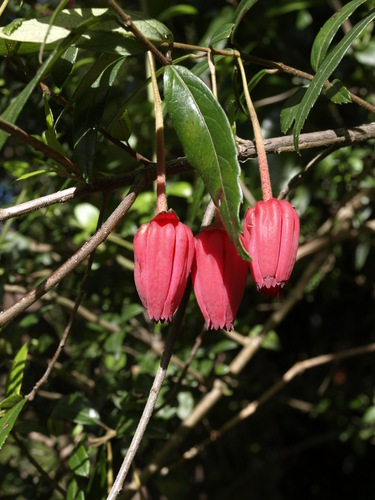
Crinodendron hookerianum is a shrub or small tree with ash-grey bark that can reach up to 8 metres (26 ft) in height, with a trunk up to 30 centimetres (12 in) in diameter. Its leaves are alternate, lanceolate with toothed edges and an acute apex, petiolate, 4–7 cm (1.6–2.8 in) long and 0.7–1.8 cm (0.28–0.71 in) wide. They are dark green on the upper surface, and hairy whitish green on the lower surface. Its flowers are hermaphrodite, solitary and axillary, and range in color from pinkish to red. Flower pedicels are around 3–6 cm (1.2–2.4 in) long. The calyx is made of 5 fused green sepals, while the corolla is campanulate, composed of 5 free petals that end in 3 teeth. It has 15–18 stamens, and the style is longer than the stamens. The fruit is a white, pubescent, leathery capsule with 3 to 5 valves, and the seeds are ovoid and glossy.
This plant is somewhat poisonous, because it contains cucurbitacins, a class of cytotoxic triterpenoids named for their frequent occurrence in genera of the cucumber and gourd family Cucurbitaceae, such as Bryonia. Contact with sap from plants containing high levels of cucurbitacins can lead to skin inflammation and blistering. Consumption of plant material containing these compounds can lead to gastrointestinal irritation with vomiting and bloody diarrhoea, tachycardia, and damage to the liver (hepatotoxicity) and kidneys, among other symptoms, and poisoning can sometimes be fatal.
In Chilean folk medicine, C. hookerianum is used as an emmenagogue and abortifacient, and its leaves and bark are considered to have emetic properties. Though toxic, the shrub is also described as "balsamic", a vague term referring to its medicinal value and aromatic constituents. It was introduced into cultivation in the U.K. by Cornish plant collector William Lobb for Veitch Nurseries of Exeter in 1848.
Its attractive flowers make it a highly valued ornamental shrub or small tree, and it has gained the Royal Horticultural Society's Award of Garden Merit. When fully grown in cultivation, it reaches approximately 8m in height and 5m in spread. It grows best in fertile, moist but well-drained, humus-rich, acid soil in partial shade. It can grow in full sun only if its roots can be kept cool and shaded, and needs placement in a sheltered woodland garden or against a south- or west-facing wall to be protected from cold, drying winds. It is hardy to −7 °C (19 °F), but young growth and flower buds are easily damaged by hard frosts; flower buds are small, formed in autumn, ripen over winter and spring, and bloom the following summer. It has been planted as far north as Scotland, and thrives in areas of western Scotland warmed by the Gulf Stream, such as at Benmore Botanic Garden. In the United Kingdom, it grows best in the generally mild climates of Cornwall and Devon; in Ireland, it thrives in the similarly mild climate of counties Cork and Kerry, such as in the garden on Garnish Island. It can also be grown in a cool greenhouse or conservatory, and will flower earlier under these conditions. In colder areas, the only pruning generally required is removal of dead wood in late spring; in milder areas in a light woodland environment, it can even be clipped to form a windbreak. It can be propagated vegetatively by greenwood cuttings in early summer, or semi-ripe wood cuttings in late summer. It is generally free of troublesome pests and diseases.