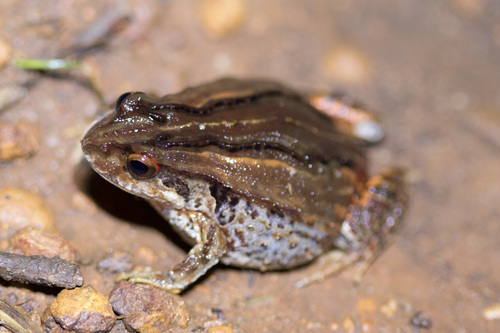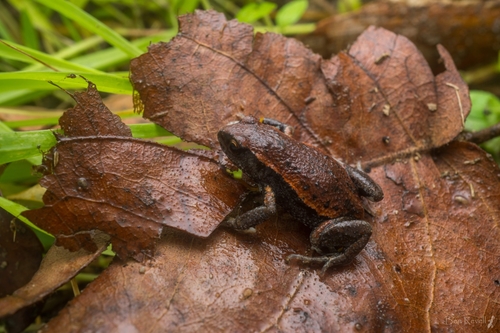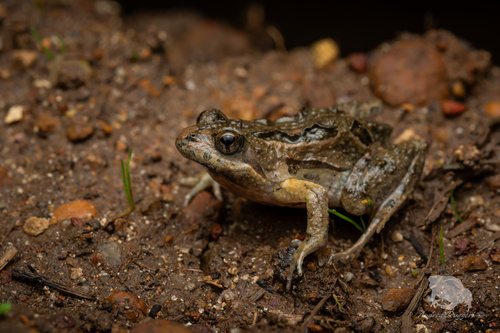
About Crinia insignifera Moore, 1954
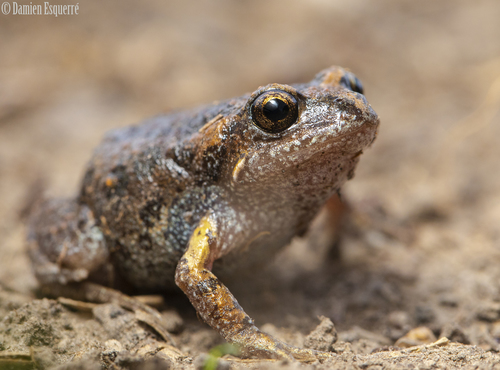
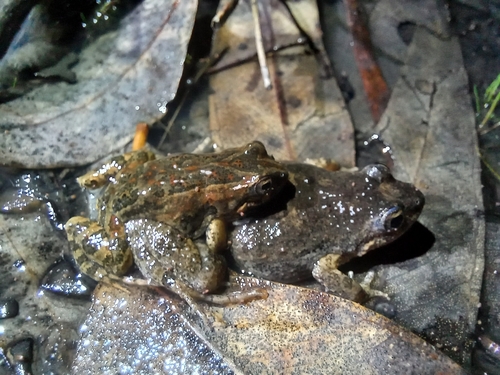
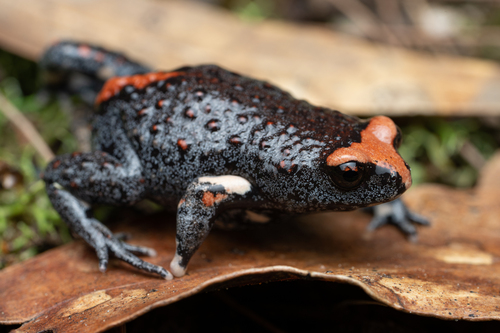
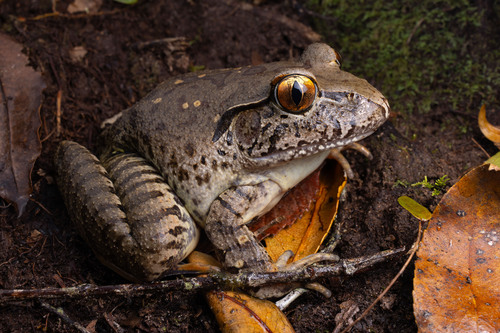
Like many other small Australian Crinia species measuring less than 3 cm, squelching froglets (Crinia insignifera) show considerable variation in dorsal and ventral colouration and patterns. Dorsal surfaces are typically medium grey and/or brown, but may have tones or patches ranging from light grey to fawn, red, gold, dark grey, or dark brown. Pattern variation ranges from solid uniform colour to blotched, marbled, and striped. Skin texture can vary from smooth to rough, and may or may not have raised longitudinal folds. Ventral patterns often show sexual dimorphism. Calling males usually have strong black colouration on the chin along the jawline, paired with a white or pale throat, though some calling males have dark throats. Most males have plain white or pale bellies. Females typically have white colouring across the chin, throat, and belly. It is not always possible to distinguish squelching froglets from rattling froglets (C. glauerti), South Coast froglets (C. subinsignifera), and bleating froglets (C. pseudinsignifera), especially when only a photo of the dorsal surface is available. Ventral surface patterns can help guide identification, but these patterns are also highly variable, so care must be taken when using them for ID. Species geographic distribution can also help identify individuals, but the ranges of these related Crinia species overlap in many locations, making misidentification common. Squelching froglets are found in southwestern Australia, restricted to the Swan Coastal Plain west of the Darling Range, between Gingin in the north and Busselton in the south. They also occur on Rottnest Island, off the coast of Perth. They occupy coastal plains, and are often found near natural swamps, creeks, and pools, but also live in pastureland, plantations, rural gardens, water storage areas, ponds, open excavations, and sewage treatment areas. Like other Crinia species, squelching froglets are thought to feed on a variety of small insects and arachnids, including mosquitoes, caterpillars, flies, and small spiders. They typically breed in creeks, swamps, or pools, including flooded or seasonally inundated grasslands or shrubby areas next to streams, gutters, and seeps. They are often found in areas that are only temporarily wet during winter. Eggs are laid singly, usually attached to the substrate in shallow water. Tadpoles take approximately five months to develop into adult frogs, and feed mostly on sediments and algae.