About Crinia glauerti Loveridge, 1933
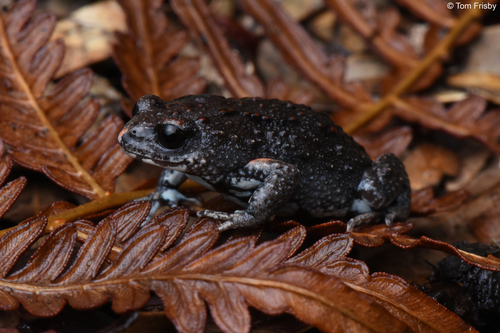
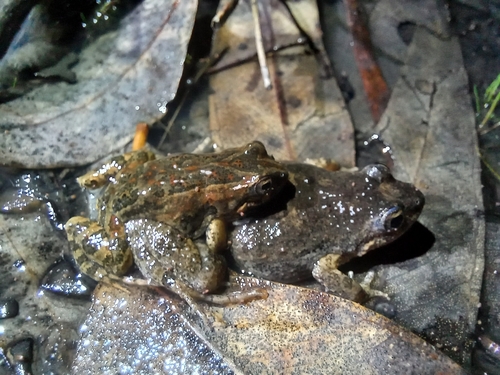
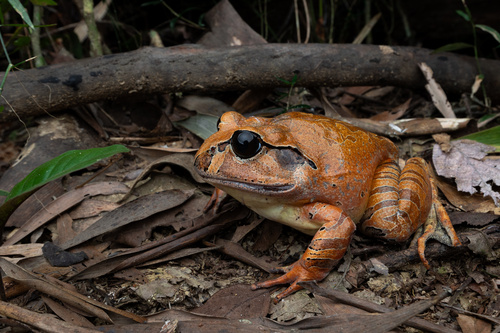
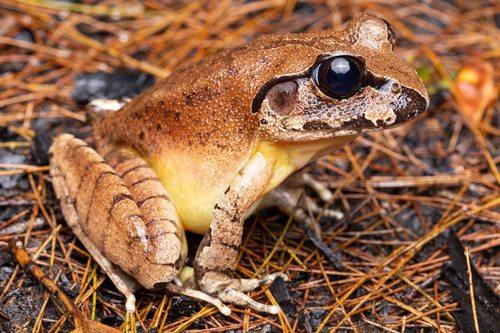
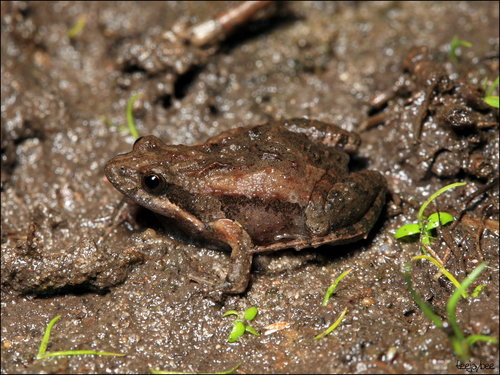
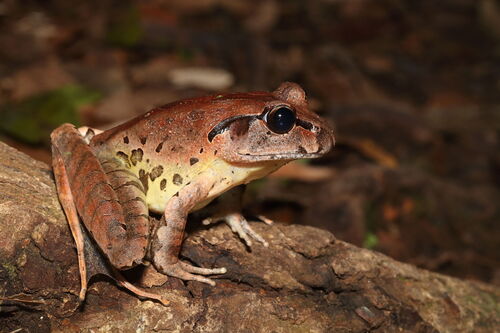
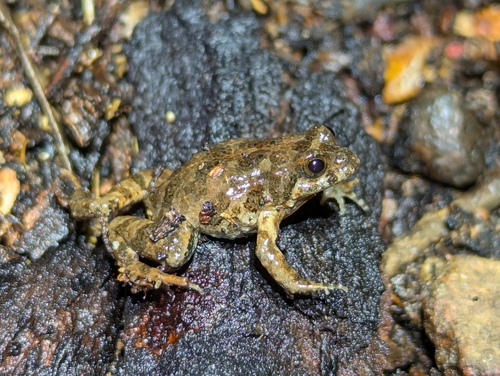
Like many other small Crinia species in Australia (all under 3 cm in length), rattling froglets (Crinia glauerti Loveridge, 1933) show significant variation in their dorsal and ventral colour and patterning. Dorsal surface colour can range from sandy gold, light grey, fawn, and brown, to bright russet, dark grey, dark brown, or nearly black. Dorsal patterns vary between solid uniform colour, blotched, marbled, and striped forms. Skin texture varies from smooth to rough, and may or may not have raised longitudinal folds. Ventral patterning is sexually dimorphic. Males usually have differing amounts of black on the chin, throat, belly, and legs, though some can be plain, while others have black and white blotching on the belly. Females usually have white colouration on the chin, throat, and belly, with variable amounts of black blotching. Individuals of both sexes can have a mid-ventral stripe or cross.
It is not always possible to distinguish rattling froglets from squelching froglets (C. insignifera), South Coast froglets (C. subinsignifera), and bleating froglets (C. pseudinsignifera), especially when only a photograph of the dorsal surface is available. Ventral surface patterning can help with identification, but these patterns are also highly variable, so care is required. Species geographic distribution can also help identify individual frogs, but many locations have overlapping ranges between these species, so misidentification is common.
Rattling froglets are native to southwestern Australia, where they occur along the coast and adjacent inland areas. Their patchy distribution extends from the Moore River area (north of Perth) south-east to the Albany region and the Stirling Ranges. They inhabit coastal plains, inland ranges, and riverine areas, and are often found near natural swamps, creeks, and pools in forests. They also occur in pastureland, plantations, rural gardens, water storage areas, ponds, open excavations, and sewage treatment areas.
Like other Crinia species, rattling froglets are thought to feed on a range of small insects and arachnids, including mosquitoes, caterpillars, flies, and small spiders. Rattling froglets typically breed in creeks, swamps, or pools, including flooded or seasonally inundated grasslands and shrubby areas next to streams, gutters, and seeps. They usually occupy areas that stay wet for most of the year. Amplexus pairs are often seen on top of floating vegetation such as duckweed in shallow water less than 50 cm deep. Eggs are laid individually, and usually grouped in small clusters or rows attached to the stems of submerged vegetation, submerged leaves, or to the substrate in shallow water. Tadpoles take approximately four months to develop into froglets, and they feed mostly on algae and sediment.