About Cricula trifenestrata Helfer, 1837
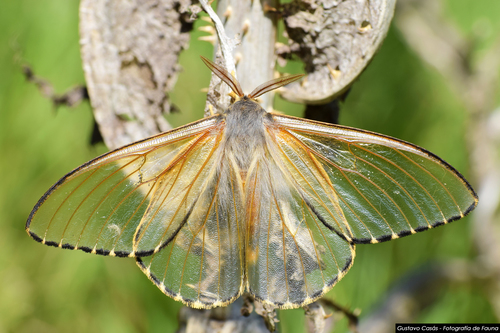
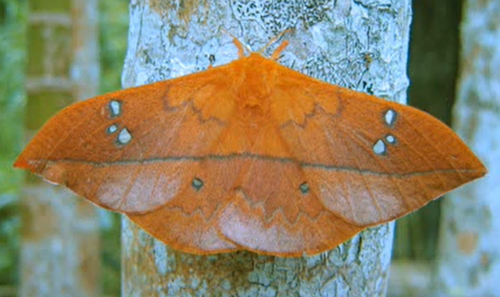
The wingspan of Cricula trifenestrata ranges from 65 to 100 mm. Adult moths are on wing from May to June, and there may be a second brood from August to September. Males range in color from brown, ochreous, and yellowish to reddish. The forewings have a wavy anti-medial dark line, a small hyaline spot beyond the end of the cell, and one or two additional spots above this spot, with the upper one being dark. The hindwings have an oblique line that extends to the inner margin before the middle of the wing, and a hyaline spot beyond the cell. The ventral side of the wings is strongly purple-toned. Females are red. Their forewings have three large, irregularly shaped hyaline spots beyond the cell, and there are often one or two small additional spots inside these larger spots. Larvae are blackish brown with red spots, and are covered in hair. Each body segment from the 2nd to the 11th has six setiferous tubercles. The first body segment and anal claspers are crimson, while the legs and prolegs are brown. Larvae have been recorded feeding on plant species from the genera Anacardium, Mangifera, Spondias, Careya, Bischofia, Canarium, Quercus, Cinnamomum, Machilus, Persea, Acrocarpus, Ziziphus, Malus, Prunus, Pyrus, Salix and Schleichera. In the pupal phase, the mouth is replaced by a tube that produces golden silk fibers, as pupae do not feed. After expelling their final frass, each pupa begins to spin a golden cocoon between one or multiple leaves. The cocoon is made of bright golden yellow silk that is firmly woven into a network. Females spin larger cocoons than males to fit their larger body size. A golden cocoon is usually completed in about 8 hours. The pupal incubation phase normally lasts 21 to 26 days, but may last 2 to 3 months under extreme climate conditions.