About Crex crex (Linnaeus, 1758)
The corn crake, Crex crex, is a medium-sized rail. It measures 27–30 cm (11–12 in) in length, with a wingspan of 42–53 cm (17–21 in). Males average 165 g (5.8 oz) in weight, while females average 145 g (5.1 oz).
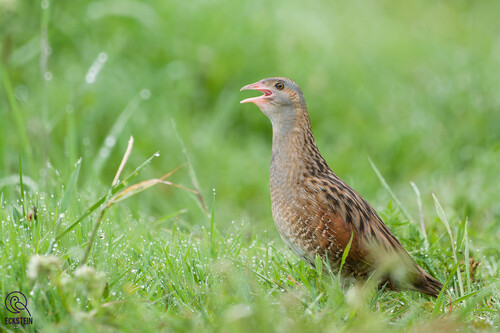
Adult breeding males have brown-black coloring on their head crown and entire upperparts, streaked with buff or grey. Their wing coverts are a distinct chestnut color marked with some white bars. The face, neck, and breast are blue-grey, with the exception of a pale brown streak that runs from the base of the bill to behind the eye. The belly is white, and the flanks and undertail are barred with chestnut and white. The strong bill is flesh-colored, the iris is pale brown, and the legs and feet are pale grey. Females have warmer-toned upperparts and a narrower, duller eye streak than males. Outside of the breeding season, both sexes develop darker upperparts and less grey underparts.
Juveniles have a similar appearance to adults, but their upperparts carry a yellow tone, and the grey underparts of adults are replaced with buff-brown. Like all rails, corn crake chicks have black down. There are no recognized subspecies, but all populations show extensive individual variation in coloring, and birds become gradually paler and greyer further east across their range.
Adults undergo a complete moult after breeding, which is normally completed by late August or early September, before they migrate to southeastern Africa. A partial pre-breeding moult occurs before their return from Africa, mainly affecting the head, body, and tail plumage. Young birds moult their head and body feathers about five weeks after hatching.
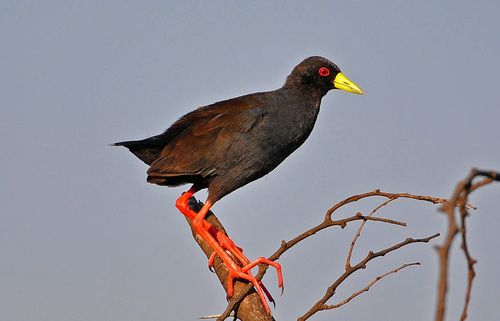
On wintering grounds, the corn crake shares habitat with the African crake, but can be told apart by its larger size, paler upperparts, tawny upperwing, and different underpart pattern. In flight, it has longer, less rounded wings and shallower wingbeats than the African crake, and shows a white leading edge on the inner wing. It is unlikely to be confused with any other rail in either breeding or wintering ranges, as co-occurring species are smaller, have white markings on the upperparts, different underpart patterns, and shorter bills. A flying corn crake may resemble a gamebird, but its chestnut wing pattern and dangling legs are distinguishing traits.
The corn crake breeds from Ireland east through Europe to central Siberia. Though it has disappeared from much of its historical range, it once occupied suitable Eurasian habitats everywhere between latitudes 41°N and 62°N. It also has a sizable population in western China, and nests only rarely in northern Spain and Turkey. Historical claims of breeding in South Africa are incorrect, resulting from misidentification of museum eggs that actually belong to the African rail.
The corn crake winters mainly in Africa, from the Democratic Republic of the Congo and central Tanzania south to eastern South Africa. North of this core wintering area, it is mostly seen during migration, but it occasionally winters in North Africa and areas west and north of its main southeast African range. Most of South Africa's population of around 2,000 birds is found in KwaZulu-Natal and the former Transvaal Province, and population numbers elsewhere in Africa are uncertain. There are multiple 19th-century records, when populations were much higher than today, of corn crakes being seen in western Europe (mainly Ireland and Britain) between December and February.
This species migrates to Africa along two main routes: a western route through Morocco and Algeria, and a more important flyway through Egypt. It has been recorded in most countries between its breeding and wintering ranges during passage, including much of West Africa. Birds from Coll that follow the western route pause in West Africa while traveling further south, and pause again on their return flight, when they also rest in Spain or North Africa. Eastern migrants have been recorded in parts of southern Asia between the eastern end of their breeding range and Africa. Further afield, the corn crake has been recorded as a vagrant in Sri Lanka, Vietnam, Australia, New Zealand, the Seychelles, Bermuda, Canada, the US, Greenland, Iceland, Brazil, the Faroe Islands, the Azores, Madeira, and the Canary Islands.
The corn crake is mainly a lowland species, but breeds up to 1,400 m (4,600 ft) altitude in the Alps, 2,700 m (8,900 ft) in China, and 3,000 m (9,800 ft) in Russia. When breeding in Eurasia, its original habitats included river meadows with tall grass and meadow plants such as sedges and irises. Now it is mainly found in cool moist grassland used for hay production, particularly moist traditional farmland with limited cutting or fertilizer use. It also uses other treeless grasslands in mountains or taiga, on coasts, or areas created by fire. It may use moister areas like wetland edges, but avoids very wet habitats, as well as open areas, and areas with vegetation over 50 cm (20 in) tall or too dense to walk through. Occasional isolated bushes or hedges may be used as calling posts. Unmown, ungrazed grassland becomes too matted to be suitable for nesting, but locally grown crops such as cereals, peas, rape, clover, or potatoes may be used. After breeding, adults move to taller vegetation such as common reed, iris, or nettles to moult, returning to hay and silage meadows for a second brood. In China, flax is also used as a nest site. Though males often sing in intensively managed grass or cereal crops, successful breeding is uncommon in these areas, and nests in field margins or nearby fallow ground are much more likely to succeed.
When wintering in Africa, the corn crake occupies dry grassland and savanna habitats, found in vegetation 30–200 cm (0.98–6.56 ft) tall. This includes seasonally burnt areas, and occasionally sedges or reed beds. It is also found on fallow and abandoned fields, uncut grass on airfields, and the edges of crops. It occurs at up to at least 1,750 m (5,740 ft) altitude in South Africa. Each individual stays within a fairly small home range. Though it sometimes occurs alongside the African crake, that species normally prefers moister, shorter grassland habitats than the corn crake. During migration, the corn crake may also be found in wheatfields and around golf courses.