About Crescentia alata Kunth
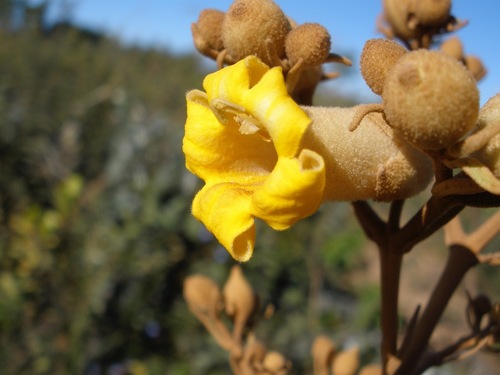
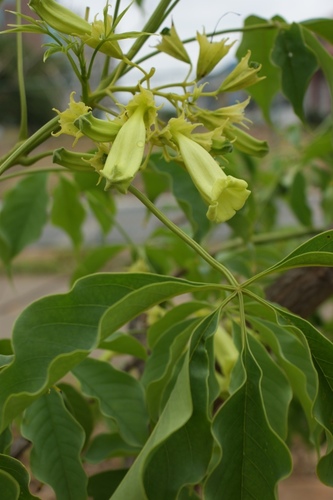
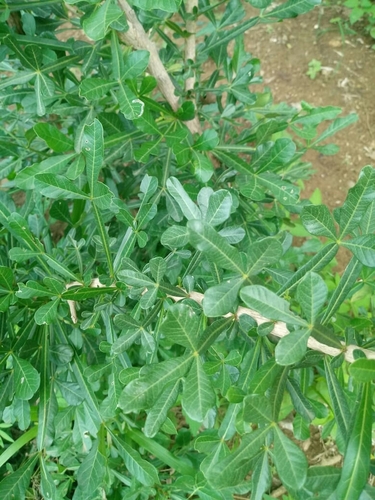
Crescentia alata Kunth is a small tree that grows up to 8 meters tall. Its leaves are similar to the leaves of the trifoliate orange, Citrus trifoliata, with a wide petiole that resembles a fourth leaflet. It produces hard, cannonball-like fruit that measure 7–10 centimeters in diameter, which are very difficult to break open. These fruit characteristics are thought to have evolved as a defense against seed predation by the region's long-extinct megafauna. Today, however, this adaptation is an evolutionary anachronism, meaning it is counter-productive: the seeds inside the fruit cannot germinate unless the shell is broken open, and apart from horses and humans, no animal native to the tree's original range can break through its fruit shells. Domestic horses have been observed smashing the fruit with their hooves, then eating the pulp and seeds, which suggests they can act as seed distribution vectors for the species. Biologist Daniel Janzen proposed that extinct elephant-like gomphotheres were originally responsible for dispersing C. alata seeds. After gomphotheres went extinct, C. alata faced increased risk from habitat loss and had extremely limited ability to migrate, but the introduction of domestic horses as a new dispersal vector has allowed the species to remain viable. Not surprisingly, C. alata is most commonly found in open areas such as pastures and fields. It is also cultivated for its gourd-like fruit: when hollowed and dried, these fruit can be used as containers for food and drink. In Central America, local people use dried, painted fruit to make artisanal handicrafts including piggy banks and ornaments.