About Crepusia fuliginosa (Olivier, 1791)
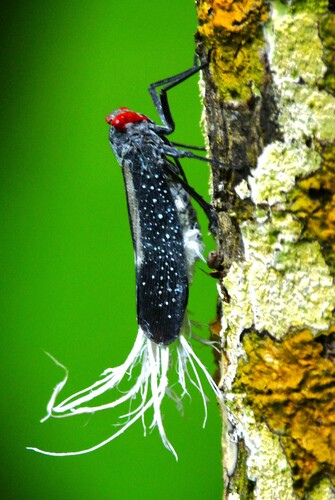
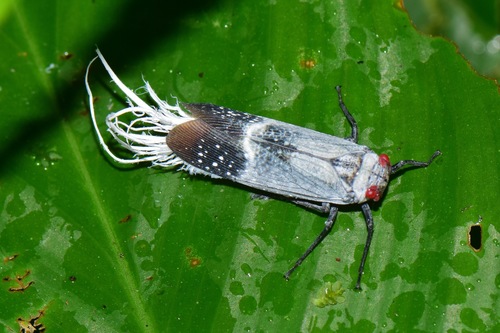
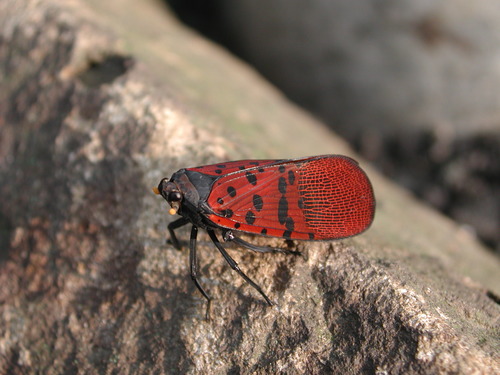
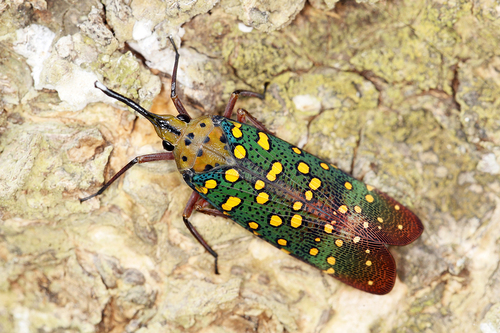
Scientific name: Poblicia fuliginosa (Olivier, 1791), originally published as Crepusia fuliginosa. Poblicia fuliginosa is mostly dark in color, with tiny pale specks across its forewings. Its head, specifically the vertex, is short and broad. The hindwings are smoky grayish-transparent, except for the proximal area, which is mostly black and marked with two pale blue splotches. The bulbous eyes do not extend beyond the width of closed forewings. The thorax and front abdominal segments are black, while the rear abdominal segments are red. Adult individuals of this species measure 8–17 mm (0.31–0.67 in) in length. The legs often bear two white bands. Nymphs are grayish-brown, with a dark brown thorax and a white head and abdomen, and have thorns or bumps covering their entire body. Like many planthoppers, P. fuliginosa prefers jumping over flying. Poblicia fuliginosa is native to the United States, where it has been recorded in the states of Alabama, Arkansas, Georgia, Illinois, Kansas, Louisiana, Maryland, Missouri, Mississippi, North Carolina, Oklahoma, South Carolina, Tennessee, and Texas. There are also some records of the species from Mexico, though these Mexican individuals may belong to an undescribed species. Poblicia fuliginosa feeds primarily on sumac (Rhus) species, especially winged sumac (Rhus copallinum). It has also been recorded feeding on red maple (Acer rubrum), though this is likely not a usual host. This species is most often found on the trunks of its host plants, while nymphs are found near the base of host trunks. Poblicia fuliginosa is hemimetabolous, going through several nymphal stages before molting into a mature adult. Its eggs are covered with a white, creamy wax. A related western United States species, Poblicia thanatophana, was formerly treated as a synonym of Poblicia fuliginosa, and feeds on Baccharis salicifolia and Brickellia.