About Crepis tectorum L.
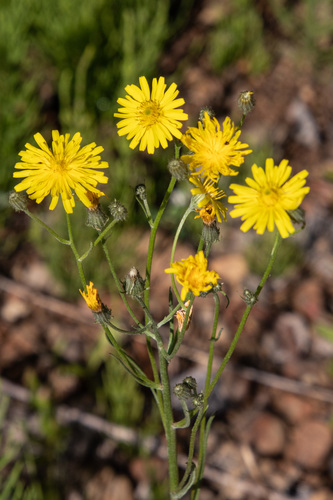
Identification: Crepis tectorum L., also called narrowleaf hawksbeard, can be identified by its long, erect stem and yellow, dandelion-like flowers. Its leaves are pointed and lobed, measuring 10–15 centimetres (3.9–5.9 in) in length and reaching up to 4 cm (1.6 in) in width. The plant's flower heads appear to hold single flowers, but they actually contain many ray florets. Morphology: Plants of this species are usually around 0.91 m (3 feet) tall, grow with a single stem, produce flowers with yellow petals, and bear 30–70 yellow ray florets per head. Distribution: This species is native to most of Europe, as well as northern and central Asia, including Russia, Kazakhstan, Mongolia, and parts of China (Inner Mongolia, Heilongjiang, Xinjiang). It is now naturalized across much of Canada, Greenland, and northern parts of the United States including Alaska, and is commonly found in the parkland zone of Alberta, Saskatchewan and Manitoba. Crepis tectorum grows in waste areas, conventional tillage fields, reduced tillage fields, forage and hay fields, and along roadsides. Habitat and ecology: Crepis tectorum is an annual weed that grows in cultivated fields and roadsides. It is highly invasive, able to overtake a field and cause serious ecological impacts to the surrounding area. It can grow in both calcareous (lime-containing) soil and lime-free soil, though it grows best in nutrient-rich clay and loam soils. It also thrives in dry, coarse soil. While it grows alongside other wild species when left unmanaged it becomes invasive. Its presence can damage soil and harm nearby native plant species by overtaking their growing area. It can be easily removed by hand, and is more effectively controlled through chemical methods. Its seed germination occurs at a temperature range of 2–4 °C (36–39 °F), with an optimal planting depth of 3–4 cm (1.2–1.6 in).