About Crepidula plana Say, 1822
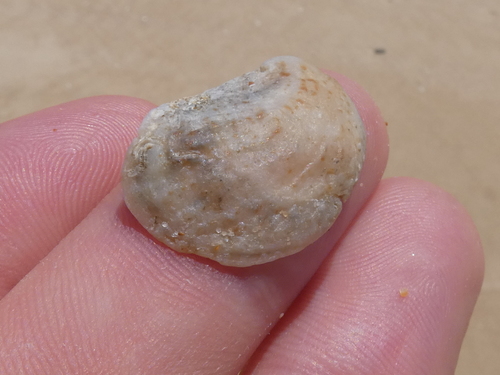
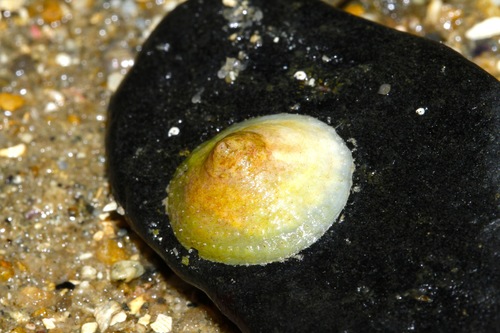
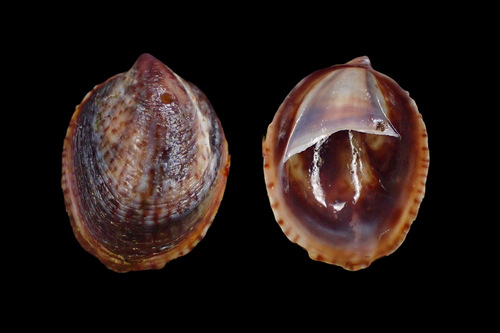
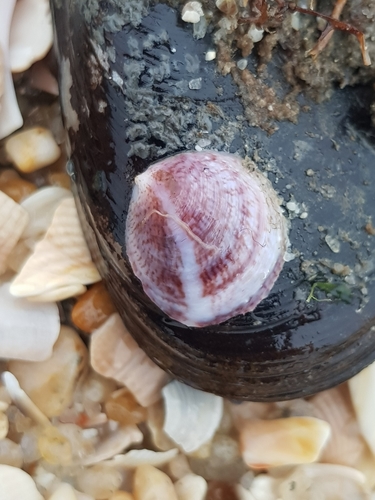
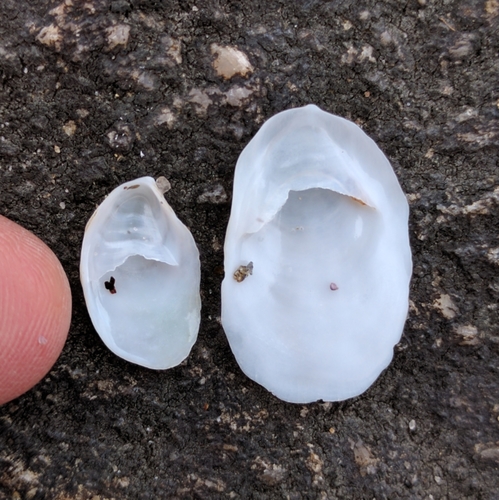
Crepidula plana Say, 1822 is a marine gastropod species. Its shell is flat, white, and has a flat internal septum, with no muscle scars visible inside the shell. Shell length measures between 15 and 35 mm, and the maximum recorded shell length for this species is 43 mm. This species produces planktotrophic larvae. Historically, Crepidula plana was reported to have a broad range spanning from 48°N to 38°S latitude, and 97.75°W to 34.9°W longitude. Most of this older distribution information is incorrect, as it was compiled before modern taxonomic revisions that split this group of similar-looking species into separate distinct species. Older sources previously listed Crepidula plana as occurring across a wide area: Canada (Nova Scotia, New Brunswick), the United States (Massachusetts, New York, New Jersey, Maryland, Virginia, North Carolina, South Carolina, Georgia, East Florida, West Florida, Louisiana, Flower Garden Banks East and West, Texas), Mexico (Tamaulipas, Tabasco, Veracruz, Campeche State, Cayo Arcas, Campeche, Yucatán State, Campeche Bank, Alacran Reef, Quintana Roo), Costa Rica, Panama, Colombia, Venezuela (Gulf of Venezuela, Sucre, Isla Margarita), Bermuda, Jamaica, the Virgin Islands (St. Croix), St. Vincent & the Grenadines (Grenada), Surinam, and Brazil (Amapa, Ceara, Pernambuco, Rio de Janeiro, São Paulo). Since the 1980s, DNA sequence data, allozyme data, and developmental data have confirmed that the flat white Crepidula found along eastern North America actually consists of at least three separate distinct species. Following this taxonomic revision, the confirmed true range of Crepidula plana extends only from Nova Scotia and New Brunswick south to Georgia or northern Florida. Older records of Crepidula plana from southern Florida and the Gulf of Mexico are almost certainly misidentifications of either Crepidula atrasolea or Crepidula depressa. Flat white Crepidula species found south of the Gulf of Mexico in the Caribbean are confirmed not to be C. plana, and their correct identity requires further re-examination. The minimum recorded depth this species has been found at is 0 m, and the maximum recorded depth is 110 m.