About Crepidula fornicata (Linnaeus, 1758)
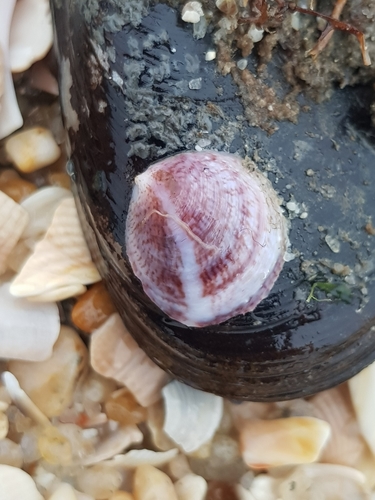
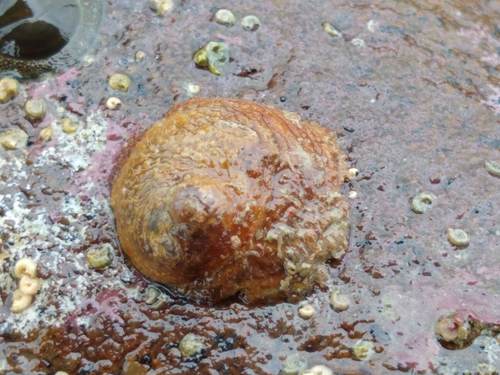
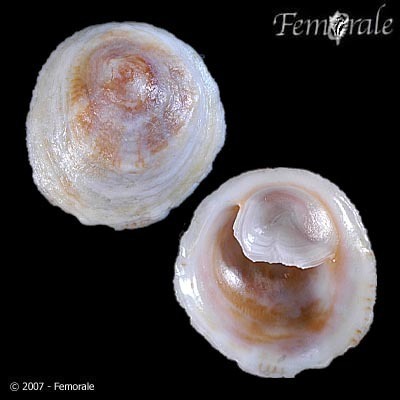
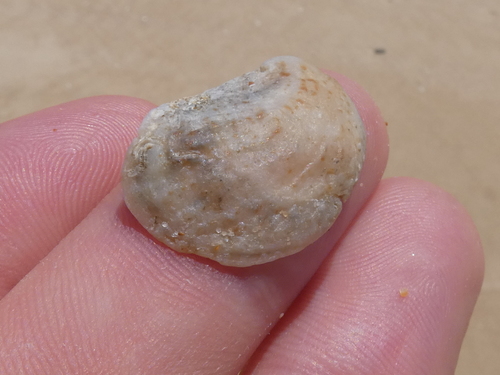
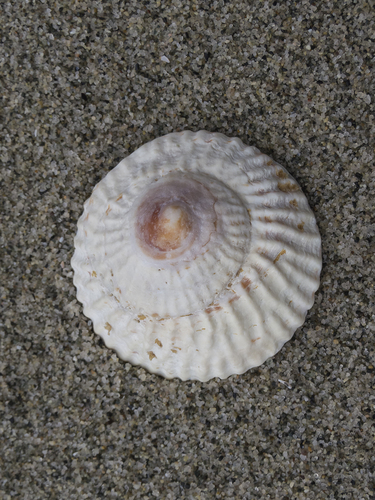
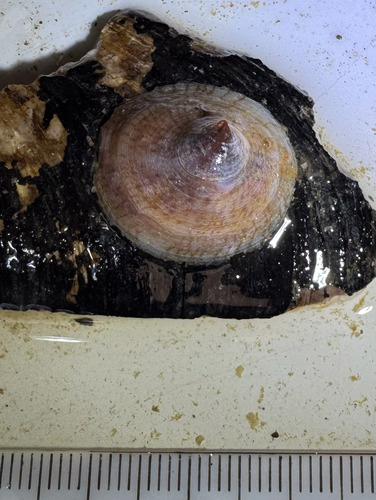
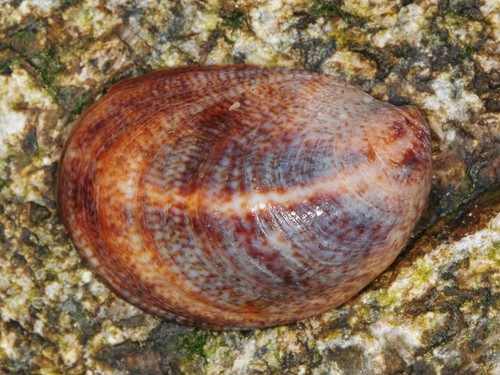
The shell of Crepidula fornicata typically measures 20–50 mm, with a maximum recorded shell length of 56 mm. This sea snail has an arched, rounded shell; a white "deck" on the inside of the shell gives it a shape resembling a boat or slipper, which is the origin of its common names. Shell shape varies between individuals, with some shells being more arched than others. Groups of individuals are often found heaped and fastened together, with larger, older females positioned below and smaller, younger males positioned on top. As the heap grows, males change sex to become females, making this species a sequential hermaphrodite. This species is native to the western Atlantic Ocean, along the eastern coast of North America. Its native distribution ranges between 48°N to 25°N latitude, and 97.2°W to 25°W longitude, covering territory from as far north as Nova Scotia to as far south as the Gulf of Mexico. It has been accidentally introduced to other regions around the world, where it has become problematic. Nonindigenous populations have been recorded in the U.S. state of Washington, the Pacific Northwest, Europe, and Japan. It was brought to Europe alongside the eastern oyster Crassostrea virginica. The first recorded individual found in Belgium was on September 28, 1911, attached to an oyster in Ostend, and it has been classified as a common species along the Belgian coast since the 1930s. It is considered an invasive species in Denmark, France, Italy, the Netherlands, Spain, and the United Kingdom, and it has also spread to Norway and Sweden. In Europe, this species has few to no predators, can thrive on several types of hard bottoms and shellfish banks, and is known to damage oyster fisheries. Its continued northward expansion is most likely inhibited by temperature, as low winter temperatures can slow or stop the species' development. Although Crepidula fornicata has a cosmopolitan distribution and can tolerate a wide range of environmental conditions, its populations develop particularly well in wave-protected areas such as bays, estuaries, or the sheltered sides of wave-exposed islands. It occurs between a minimum depth of 0 meters and a maximum depth of 70 meters. Individuals are often found stacked on top of one another, attached to rocks, horseshoe crabs, shells, and dock pilings. As noted, Crepidula fornicata is a sequential hermaphrodite. It normally forms stacks of up to 12 individuals, with the largest individual at the bottom and increasingly smaller individuals stacked above. The largest, oldest animals at the base of the stack are female, while the younger, smaller animals at the top are male. If females in the stack die, the largest male in the stack will transition to become a female. Breeding can occur between February and October, with peak activity in May and June. Roughly 80-90% of females spawn during May and June, and most females spawn twice per year, generally after neap tides. Multiple avenues are being explored to identify an ideal target market and effective marketing strategies for this shellfish as food. Slipper limpets are a versatile food product; their flavor and distinct character work as a standalone main course, an appetizer, or as an ingredient incorporated into a wide range of dishes. Slipper limpets release a significant amount of liquid before, during, and after cooking, which can be boiled down to make broth or stock, and can also be used as a substitute for clam juice. Recipes using slipper limpets have been published in Scottish cookbooks; the species is considered a delicacy in Hawaii, and it is a valued ingredient in traditional cultural dishes of the Azores. Even though it is an invasive species in France, there are ongoing attempts to harvest and market the snail for food there.