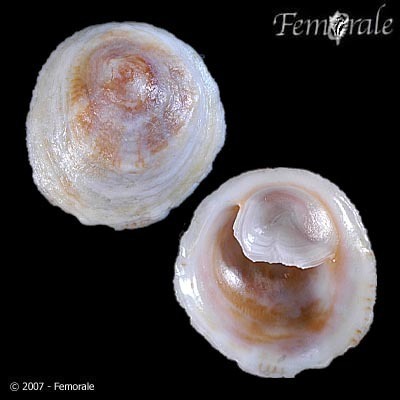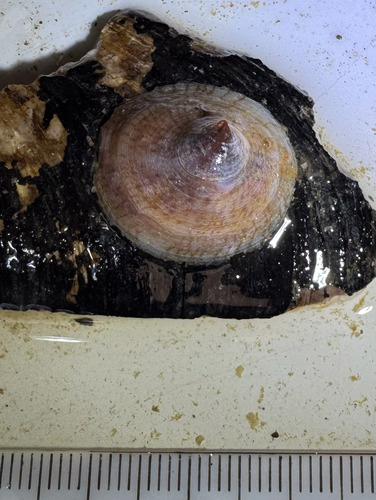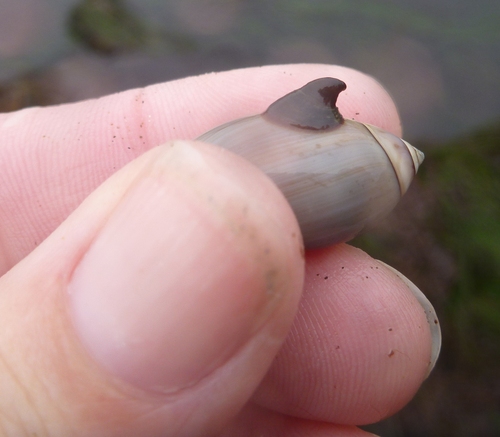
About Crepidula adunca G.B.Sowerby I, 1825
Crepidula adunca G.B.Sowerby I, 1825 is a suspension-feeding mollusk; it is a sequential hermaphrodite that broods its young. Members of this species form long-term epizootic associations, and females are typically larger than males, though size overlap can occur between males and females of both stacking and non-stacking individuals. A stacking species is one where individuals attach to one another to form a stacked group. C. adunca has dense patches of cilia around the mouth near the head, located between the tentacles, and on the foot; the foot develops earlier than any other structure. Young are held in capsules inside the parent's mantle cavity, which also houses other organs. Juveniles leave the parent once they reach adult size and have developed all organs except reproductive organs. All young start life in a male phase before changing to a female phase later in life, a process called sequential hermaphroditism. The claim that solitary males and males surrounded by females undergo this sex change at different times has been disproven for C. adunca, as there is very little difference in timing between the two groups. This species is distributed in the Eastern Pacific Ocean, ranging from Canada to Baja California, Mexico. C. adunca is most often found in semi-permanent stacks of two individuals, which usually contain more females than males. This species does not reproduce successfully in the mid-intertidal zone, at 20–30 meters. Adults in these epizootic associations are inactive, and the shell of C. adunca grows to match the shape of its host's shell. Mobile juveniles must select long-term host animals that lower their risk of death, but once individuals reach a certain size, they cannot voluntarily leave their host. C. adunca prefers warm weather, and climate change has led to an increase in this species' population. Larger females tend to have a greater average abundance of gametes. Females typically produce the same number of eggs per capsule regardless of their current developmental stage. Embryo development takes place inside capsules, and multiple eggs are enclosed in each capsule. All embryos within a capsule develop at the same time and at the same rate. C. adunca embryos hatch as crawling juveniles. Eyes are the first structure to develop, before any other features, followed by the formation of kidney cells near the side of the ciliated mouth. Juveniles are capable of filter feeding immediately after hatching. Unlike other Crepidula species, which only develop one embryonic kidney, C. adunca hatchlings develop multiple embryonic kidneys. This indicates C. adunca is a direct developer, and it also does not develop an operculum. For most Crepidula species, the phallus reaches full size once the spermatic vesicles are filled with sperm, and outgrowth from the juvenile shell only begins after this point. C. adunca is an exception to this pattern: its phallus begins growing immediately at hatching. C. adunca broods its young year-round, and brooding patterns do not differ between stacking and non-stacking females. It is oviparous, meaning embryos develop inside eggs. A polar lobe forms during the first two mitotic cell divisions, a process that takes approximately 42 hours. Once initial cell divisions are complete and the head and foot are not yet fully developed, a shell begins to grow over the embryo. The shell develops color pigments before it is fully grown. Hatching occurs once all the yolk has been absorbed. Embryonic development inside eggs takes approximately four months. When they hatch, the gills and radula are already fully developed and do not require further growth. The only remaining larval traits retained after hatching are the embryonic kidneys and head vesicle that developed inside the egg. The shell has not yet reached full adult size when hatching occurs, but it is already bilaterally proportional to the newly hatched juvenile.