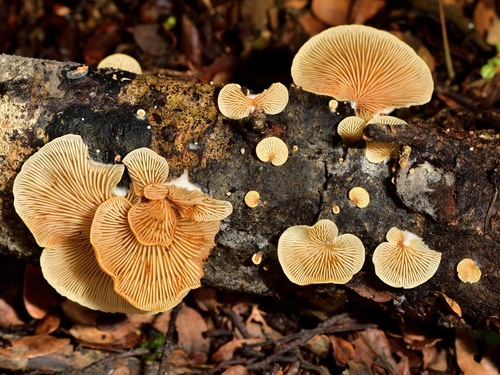
About Crepidotus praecipuus E.Horak
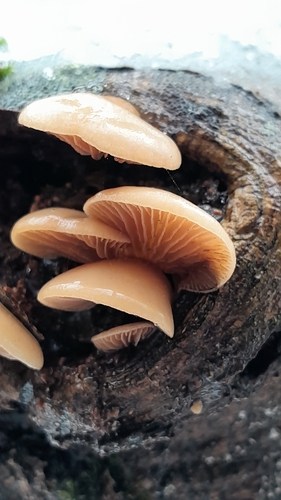
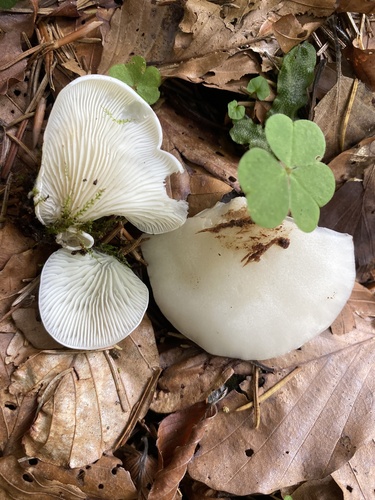
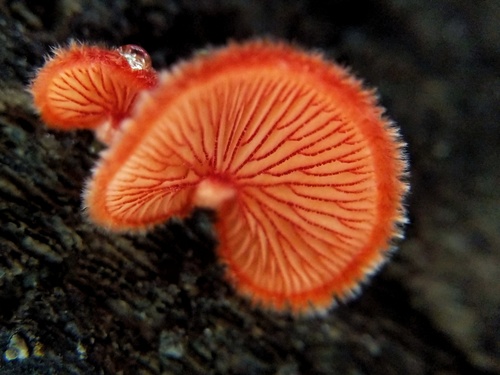
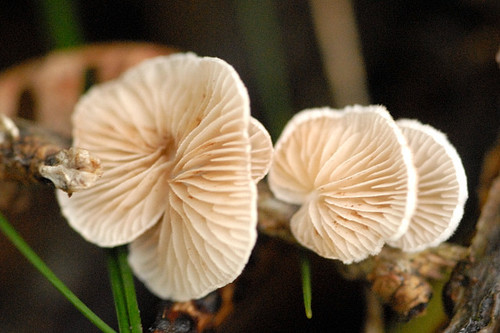
Crepidotus praecipuus E.Horak has a cap (pileus) typically 1–7 cm in diameter, that is generally convex in shape with an even, in-curled margin. Its exact shape ranges from flabelliform to semicircular to kidney-shaped, depending on the surface it grows from. When growing from a vertical surface, it usually forms a typical shelf-like structure that takes on the commonly described kidney shape, and remains visually semicircular when viewed from above. If the fungus protrudes from underneath its substrate (usually a log), it will instead appear more circular, with its point of attachment directly on top of the cap surface. The cap surface is covered in yellowish-brown to brown fibrillose scales, and has a finely felted (tomentellous) surface on one side. This scaly side is where the stipeless cap attaches laterally to its substrate. On the underside of the cap, the gills (lamellae) are somewhat fringed, and are classified as free, with no stipe to connect to. Gill colour changes with spore maturity, ranging from off-white when young to yellow-brown or rusty-brown as spores mature. The spore print of C. praecipuus is yellow-brown, matching the mature colour of the gills. The ellipsoid-shaped basidiospores are 6.3-7.8 by 5.1-6.6 µm in size, with smooth exteriors and thick walls. The apex (top) of the basidiospore can be blunt, depressed, or occasionally pointed. The basidia of C. praecipuus measure 26-65 by 4-14 μm in size, are club-shaped to cylindrical, and each has four spores attached to its top. The entire basidiomata of this species is relatively larger than that of related species, ranging from 1–7 cm in length; this larger size is a defining characteristic that sets C. praecipuus apart from other similar species. This fungus has no stipe (stem) and no annulus (ring). As of 2022, C. praecipuus has been recorded in three countries: New Zealand, Australia, and South Korea. In New Zealand, Landcare Research classifies this species as indigenous but not endemic, as it is also present in Australia. In 2021, South Korea’s Ministry of Environment reported the species was found on Daecheongdo, an island located 210 km northwest of the mainland in the Yellow Sea. This island was completely cleared by bombing during the Korean War in 1950, and no artificial reforestation has been carried out there since the 1970s, so all existing vegetation there is naturally established. In the southern hemisphere, C. praecipuus is generally found in southern beech forests, growing on dead woody material. In South Korea, the species occurs in forests dominated by Carpinus turczaninoxii, Camellia japonica and Quercus sp., with a widespread distribution of Pinus densiflora pine trees throughout these forests. In these Korean forests, C. praecipuus has only ever been found growing on dead deciduous branches. Although it grows on woody material, C. praecipuus is not parasitic; its spores only colonize dead material, not living organisms. As a saprotrophic fungus, it plays an important role in its habitat by breaking down organic material into molecules that can be reused by other organisms, and clearing space for other organisms to grow. Its fruiting season occurs in autumn (May in New Zealand, September in Korea), and occasionally occurs after periods of warm rain. The visible mushroom used to identify the species is just the fungus’s fruiting body. Fruiting only happens at specific times of year to release basidiospores; the majority of the organism remains hidden within its substrate for the rest of the time. Initial spore release is triggered by various climatic changes: water drops hitting the cap can shake spores loose from the basidium, mist can trigger detachment, and wind can carry spores away from the gills. Released spores can travel at high altitudes across vast distances, including entire oceans. The total distance a spore travels typically depends on the spore’s mass and its travel velocity. Spore travel ends when steady rain clears most suspended particles from the atmosphere. Once a spore lands on a suitable substrate, it germinates through its apex in the presence of water, and grows outward in all directions through the substrate. Only the growing tip of the hypha obtains nutrition, so the hyphal tissue behind the tip continuously dies off. When the hypha encounters another mycelium of the same species, the two fuse, and form a new fruiting mushroom body during the next fruiting season.