About Crax alberti Fraser, 1852
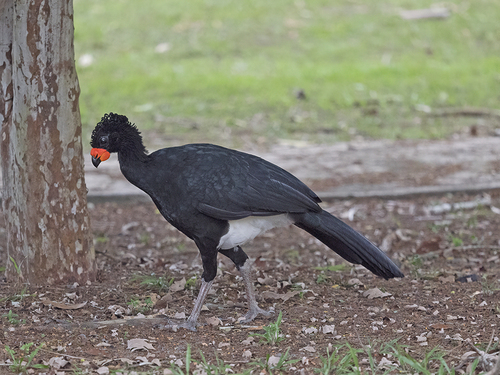
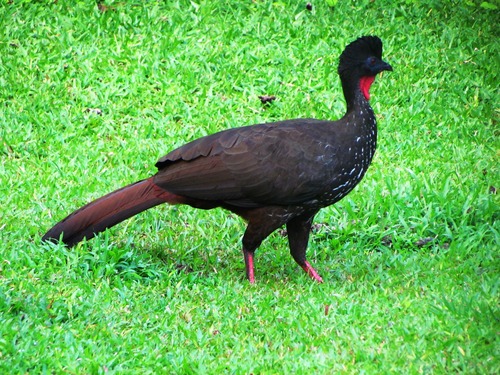
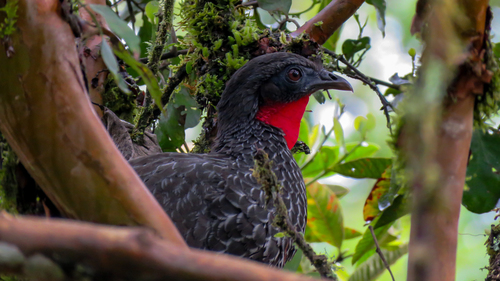
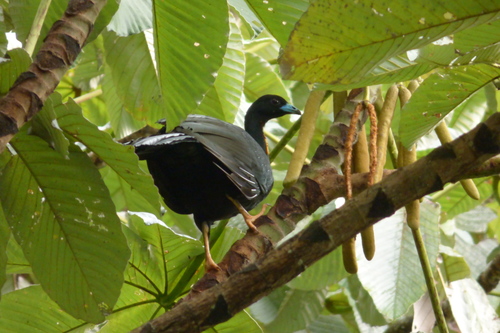
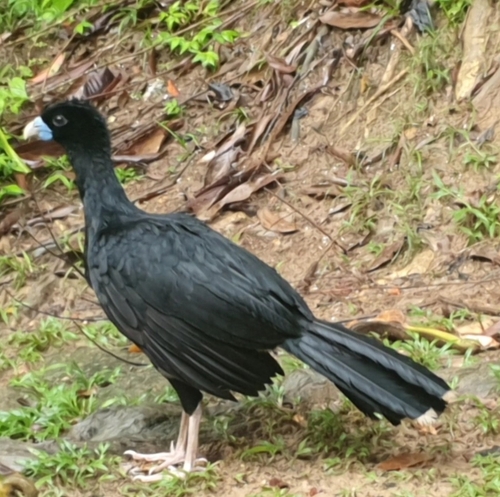
The blue-billed curassow (Crax alberti Fraser, 1852) measures 82.5 to 92.5 cm (2.7 to 3.0 ft) in length and weighs 3.2 to 3.6 kg (7.1 to 7.9 lb). It is the only curassow species that has a blue cere and blue wattle; the wattle is only present on male individuals. Males are mostly black, with a white vent and white tail tip. Females are also mostly black, but their lower belly and vent are rufous. Females have fine white barring on their wings and tail, and a rare "barred" morph of females also has barring on the breast and belly. Both sexes have an erectile crest; the male's crest is black, while the female's crest is black and white. The blue-billed curassow is found exclusively in northern Colombia. Its historical range covered 106,700 square kilometers, but it now has a highly fragmented range that spans 2,090 square kilometers, with small scattered populations located between La Guajira and Magdalena Departments, and extending south to Antioquia and Boyacá Departments. This species lives in undisturbed forest in the tropical and upper tropical zones. Most of its current range occurs from near sea level up to 600 m (2,000 ft), though it formerly occurred at elevations of at least 1,200 m (3,900 ft). The last viable population of blue-billed curassows lives in the Serranía de las Quinchas area of the Magdalena Valley.