About Crateva tapia L.
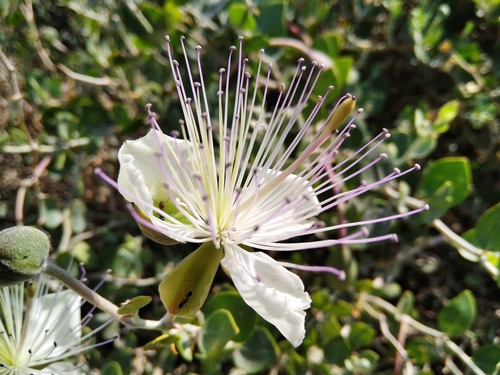
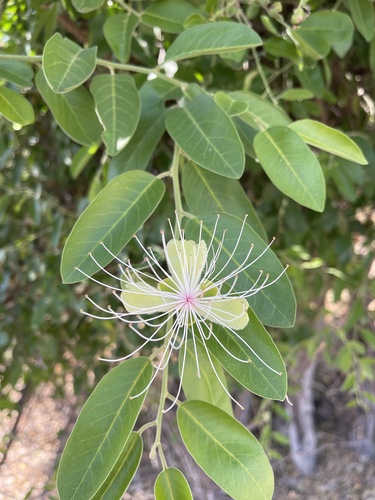
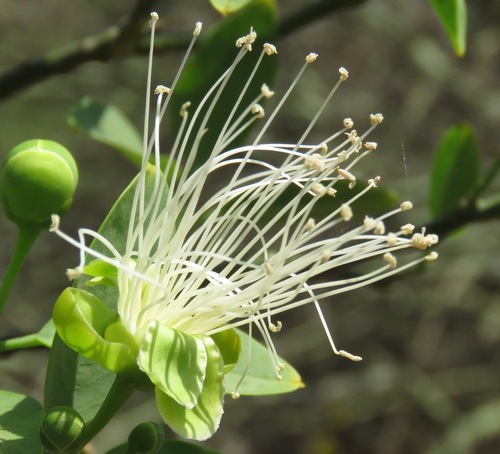
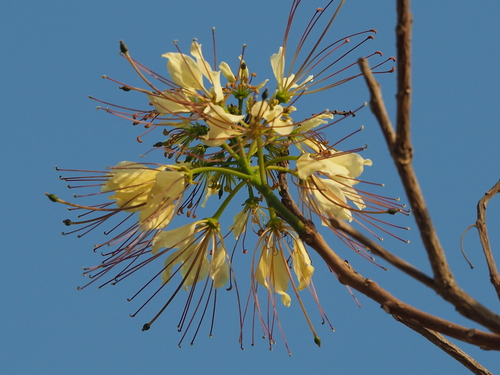
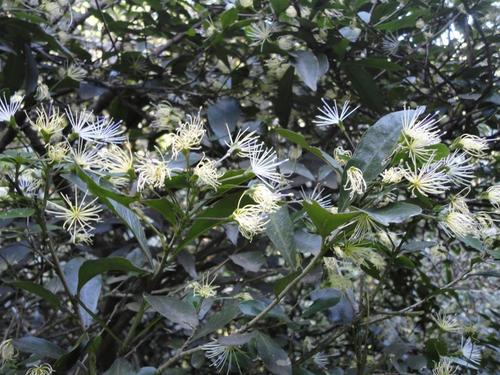
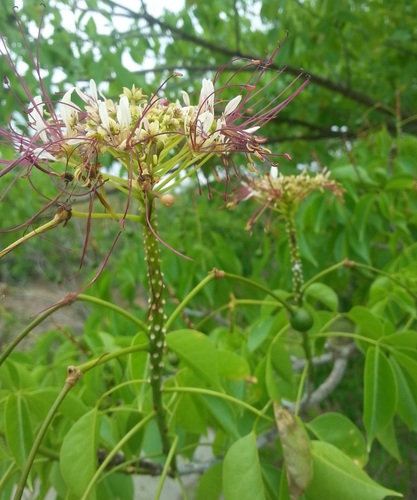
Crateva tapia L. (also spelled Crataeva tapia) grows as trees or shrubs 2 to 25 meters tall, with crowns that can reach up to 20 meters in diameter. Its bark is opaque, ranges in color from light brown to grey, and the entire plant is completely glabrous. Its leaflets vary in shape from broad to narrowly elliptical, broadly ovate, or obovate-elliptical; lateral leaflets are more or less obliquely asymmetrical. Leaflets measure (3–) 8–13 (–18) cm long and 2–9 cm wide, with an apex ranging from long acuminate to rounded and abruptly acute, and a base ranging from cuneate to obtuse (or nearly rounded), tapering gradually or abruptly toward the petiolules. The underside of leaflets is glaucous or minutely papillose. Petiolules are very distinct and measure (4–) 6–10 mm long, while petioles measure 5–15 cm long. Inflorescences form at the terminals of new leafy branches, holding 30 to 120 total flowers, with only 10 to 20 blooming at the same time. Raceme axes are 6–16 cm long and 5–10 mm wide. Bracts are linear-lanceolate, up to 9 mm long, and drop off quickly. Pedicels measure 20–32 mm long. Sepals are lanceolate to oblong or ovate, acute, with a free limb portion around 5–9 mm long and 2–3 mm wide. Petals measure 10–45 mm long and 3–7 mm wide; the petal blade is 8–30 (–35) mm long and 3–7 (–13) mm wide, colored white to greenish white, turning cream, pink, or pale purple when wilting. The petal claw is 5–11 mm long. There are 14 to 20 stamens, with filaments around 35–46 mm long that are tiny in pistillate flowers. The gynophore is 29–54 mm long, or only up to 1–5 mm long in staminate flowers. Infructescences on leafy branches measure 6–18 cm long and 5–10 mm wide, with well-spaced pedicel scars. The fruit is a globular to oblong or ovoid berry, 4–9 cm long and 3.5–6.5 cm wide, that changes color to yellow, orange, or pink as it matures. The pericarp is 4–6 mm thick when immature and 1–2 mm thick when mature, and the fruit is filled with fleshy pulp. Gynophores on mature fruit measure 30–50 (–70) mm long and 3–4 mm wide, while pedicels measure 20–60 mm long. Fruits produce numerous dark-colored seeds, which are 8–9 mm long, 6–7 mm wide, and 3–4 mm thick. The fruit pulp has a sandy consistency, is edible, and has a sweet-sour taste. This species is widely distributed from Mexico to southern Brazil. It is common in dry forests and disturbed sandy soil areas, occurring across all zones at altitudes from 0–500 (–1000) m. It flowers from (December–) February to June, and fruits from February to September (December). It is a highly variable species. When growing in dry environments, it closely resembles Crateva palmeri, with which it is apparently sympatric and possibly hybridizes. It can be differentiated from C. palmeri by its completely glabrous leaves or inflorescence axes, its white flowers, and its stalked leaflets.