About Craterostigma plantagineum Hochst.
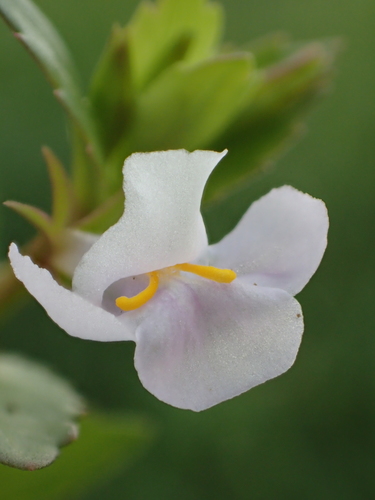
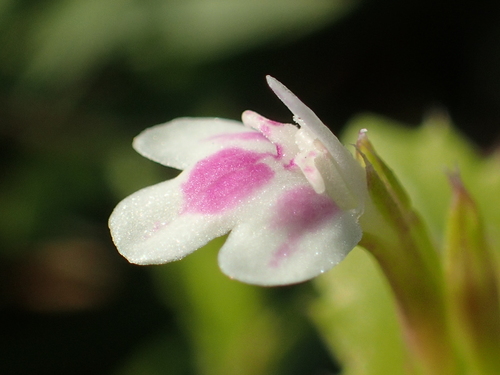
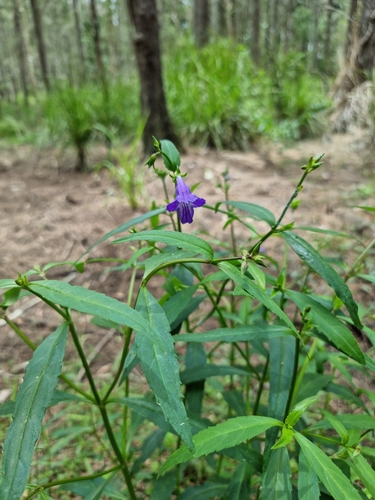
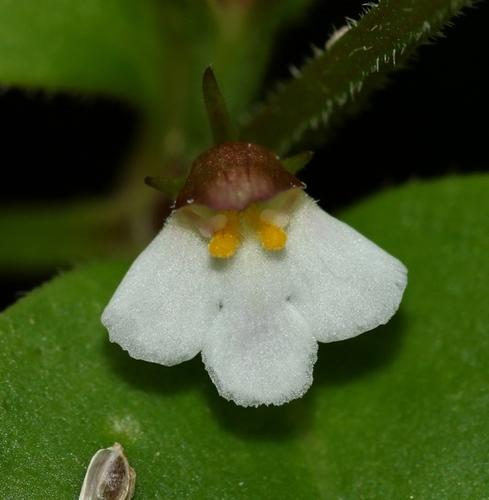
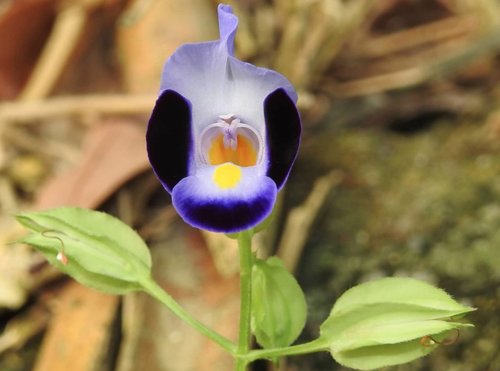
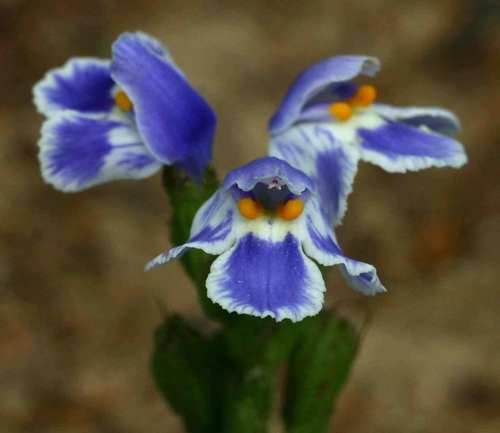
Craterostigma plantagineum Hochst. has an orange-red to yellow rhizome, with hairy roots growing below it. It forms a leaf rosette, and leaf shape is variable, ranging from narrow elliptic and lanceolate to broadly ovate. Leaves are approximately 50 mm in diameter. Leaf surfaces can be lightly hairy on both sides, or hairless on the upper surface and hairy on the lower surface. Leaves are conspicuously veined or ribbed, with purple or pink veins or ribs on the underside. Above the leaf rosette grows a small hairy stem, which can be branched or unbranched. The stem is usually 51–76 mm (2–3 in) tall or shorter, and is quadrangular in cross-section. This species blooms in summer, typically between October and May, with flowers appearing one week after the first rains. Flowers grow at the ends of stems, and measure 0.3–1.0 cm (0.12–0.39 in) in length. The flowers are blue or purple with a white throat. They have 5 broad lobes, and two yellow or orange spot-shaped honey guides at the throat that act as false stamens. The true stamens are fused under the flower’s hood, where the bilobed stigma is located. After flowering, this species produces an ovoid, cylindrical fruit capsule that is glabrous and smooth. Craterostigma plantagineum is native to parts of tropical Africa and temperate Asia. In Africa, it can be found in Chad, Ethiopia, Somalia, Sudan (including the Didinga mountains in southern Sudan), Kenya, Tanzania, Uganda, Burundi, the Democratic Republic of the Congo, Rwanda, Niger, Angola, Zambia, Zimbabwe, Botswana, Namibia, and South Africa. In Asia, it occurs in India, and in Yemen on the Arabian peninsula. It grows in shallow soil over rock, along the edges of murram dirt roads, on poor pasture lands, and in wooded grasslands. It grows in lowland areas at altitudes between 900 and 2,200 m (3,000–7,200 ft) above sea level. It is cultivated for garden use in East Africa. In Botswana, it is used in traditional folk medicine: an infusion of the roots is taken to treat abdominal pain, and an ointment made from the plant is applied to the face as a lucky charm.