About Crassula rupestris Thunb.
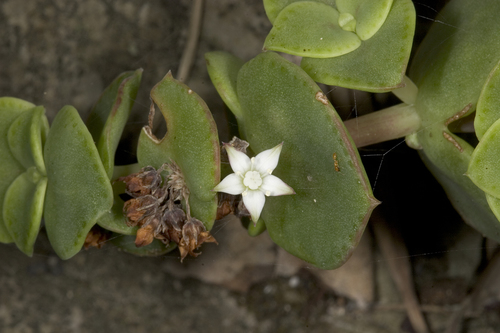
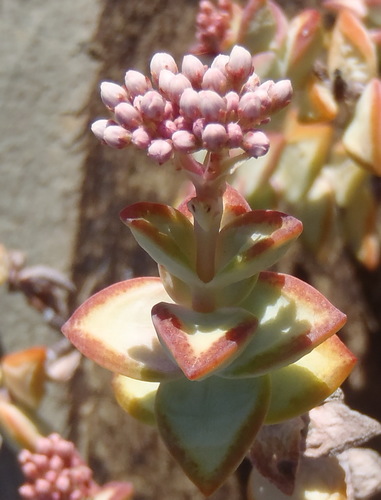
Crassula rupestris Thunb. is a heavily branched, rounded succulent shrub that grows up to 600 millimeters tall, with fibrous roots. Its young shoots are green and 2 millimeters thick; as they age, they turn gray-brown, reach 5 millimeters in diameter, and develop peeling bark. The plant has flattened leaves that measure 13 to 18 millimeters long and 10 to 15 millimeters wide. The upper leaf surface is flat to convex, and becomes concave toward the leaf base; the underside of the leaf is convex. The broadly egg-shaped, hairless, gray-green leaf blade has a powdery texture. It narrows at the base and fuses to the opposite leaf. The leaf margins are smooth and reddish, and the leaf tip can be either pointed or blunt. When exposed to intense sunlight, the entire plant takes on a reddish coloration. Crassula 'Springtime' is a cultivar of this species, with distinctively thick leaves and showy blooms. Its rugged, triangular leaves stack along thin stems that grow up to 6 inches tall. For cultivation, this species prefers well-drained soils with a high sand content. It can be grown in full sun year-round, though it benefits from shade during the hottest hours of summer. Watering should be frequent in summer, and almost completely stopped in winter. It is suited to USDA Hardiness Zones 9b to 12. It should not be exposed to temperatures below 55 °F (13 °C), and must never be exposed to temperatures below 25 °F (−4 °C); the preferred minimum temperature range is between 41 and 50 °F (5 and 10 °C). This plant can be propagated both by seed and by cuttings.