About Crassula perfoliata L.
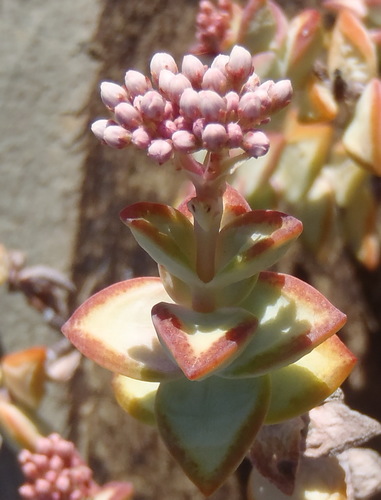
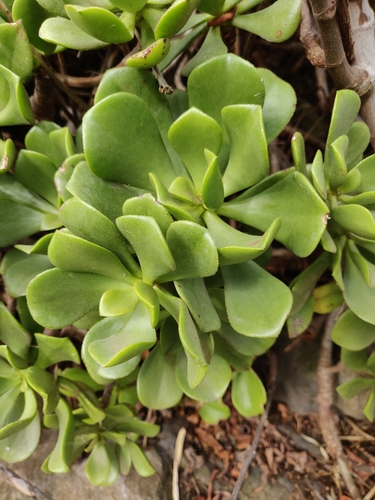
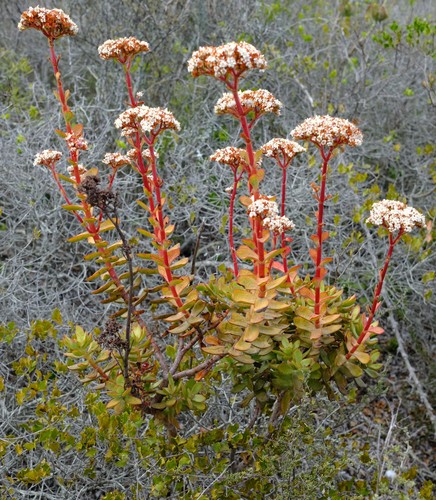
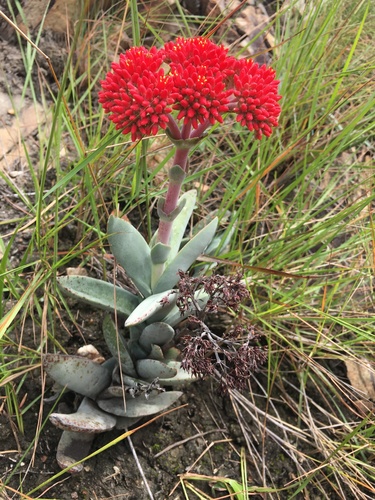
Crassula perfoliata L. is a succulent evergreen subshrub that grows to 1 metre (3.3 feet) tall and around 1 metre wide. It is recognizable by its thick, greyish-teal, sickle-shaped foliage that can reach 90 by 28 millimetres. Its leaves are arranged in opposite rows, often marked with red, and emerge in a criss-cross or rosette formation on an ever-lengthening compact stem. The stem may produce aerial roots to allow the plant to spread further. The surface of its leaves is covered in small, rounded papillae, and leaf margins are lined with very small teeth. The Latin specific epithet perfoliata translates to "with the leaves surrounding the stem". This species grows primarily on drier, partially exposed lower slopes and canyon walls, which provide sufficient root drainage and aeration. Its natural range extends from the Groot Winterhoek range of Western Cape to Port Elizabeth (Gqeberha) and Umtata (Mthatha) in the Eastern Cape of South Africa. It occurs on rocky outcrops, in meadows, on inaccessible cliffs, and in well-protected river valleys. It is restricted to quartzite sandstone outcrops, rarely shale, across the Groot Winterhoek, Cape Fold Belt, and areas from south of Umtata extending to the northeast. Crassula perfoliata cannot tolerate freezing temperatures. In temperate regions, it must be grown under glass in a greenhouse during the coldest seasons, or moved indoors to a very sunny southern or western window. Without adequate sun, plants will become distended and stretch toward light, a common issue for indoor-grown succulents. When repotting, plants should ideally be potted in a loose, well-aerated substrate. Acceptable base substrates include coconut husk or fiber, potting soil, commercial orchid or cacti mixes, and organic compost. A small amount of earthworm castings (vermicompost) can be added as a source of nutrition. Like many succulents, Crassula perfoliata is not a heavy feeder and does not need intense or regular fertilization. Occasional, well-diluted fertilization applied once a month during the growing season will not harm the plant. Granulated or pelleted timed-release fertilisers are also beneficial, as they release nutrients only when soil is wet and can last between three and six months. Regardless of soil composition, water must drain freely from the substrate to avoid the risk of root rot. Substrates for succulents like Crassula perfoliata should be amended with inert inorganic materials to improve aeration; suitable materials include perlite, pumice, gravel, decomposed granite, sand, or a mixture of these. This species can also be damaged by excessive sun exposure, which appears as scarring, burning, or chlorotic yellowing foliage.