About Crassula ovata (Mill.) Druce
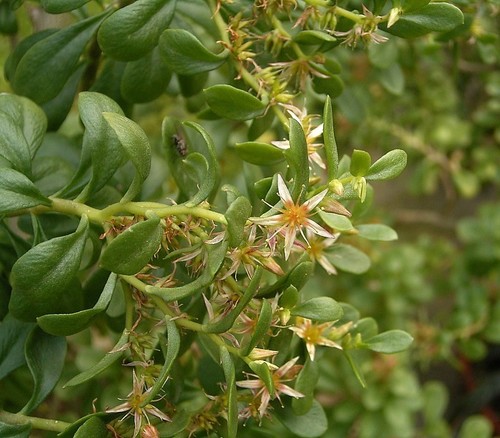
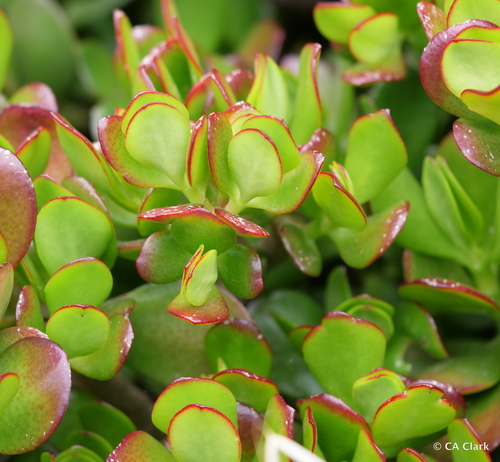
Crassula ovata, commonly known as jade plant, is an evergreen succulent shrub with thick branches. It produces thick, shiny, smooth leaves that grow in opposing pairs along its branches. Most leaves are a rich jade green, though some may appear more yellow-green, and some varieties develop a red tinge on leaf edges when exposed to high levels of sunlight. New stem growth matches the color and texture of the leaves, and becomes woody and brown as it ages. This plant grows as an upright, rounded, thick-stemmed, heavily branched shrub, reaching a maximum height of 2.5 meters (8.2 ft). Its base is usually sparsely branched, and sometimes forms a single main trunk up to 9 centimeters (3.5 in) in diameter. Its succulent shoots are gray-green. The bark of older branches peels off in horizontal, brownish stripes. Even though stems turn brown and appear woody with age, they never become true lignified tissue, and stay succulent and fleshy throughout the plant’s life. The oppositely arranged, ascending to spreading green leaves have short stalks up to 5 millimeters long. The fleshy, smooth, obovate, wedge-shaped leaf blade measures 3 to 9 centimeters (1.2 to 3.5 in) long and 1.8 to 4 centimeters (0.71 to 1.57 in) wide. The sharp-edged leaf margins are often reddish. Numerous varieties and cultivars of Crassula ovata have been selected, and C. ovata 'Hummel's Sunset' has earned the Royal Horticultural Society's Award of Garden Merit.
Some sources claim that certain species in the Crassulaceae family, including jade plant, are toxic to horses, cats and dogs, and mildly toxic to humans through skin contact, but these claims remain unproven. Crassula ovata is known to be used as a medicinal plant in some regions.
As a succulent, Crassula ovata needs very little water in summer, and even less in winter. It is vulnerable to overwatering, especially during the cold season, and excessive watering can cause leaf drop and root rot. However, a lack of water can also damage the plant. It should be grown in a porous substrate with good drainage, and the ideal substrate varies based on the climate where it is grown. It requires 4 to 6 hours of direct sun or medium shade with bright light each day. In regions with mild climates, it can withstand light frost as long as its substrate is kept dry. When grown in bright sunlight, C. ovata may develop a red tinge around its leaves. In more intense sun exposure, the plant’s green color fades and may turn yellow. This change happens because the jade plant produces pigments such as carotenoids to protect itself from harsh sunlight and ultraviolet rays. The plant also flowers in winter, particularly during a cool, dark, dry period. C. ovata is sometimes attacked by mealybugs, a common pest that affects succulents.