About Crassula decumbens Thunb.
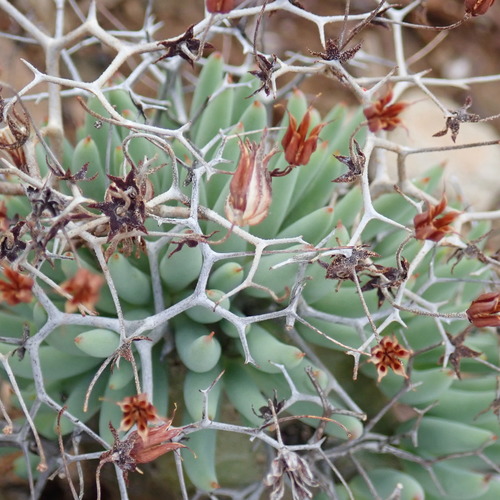
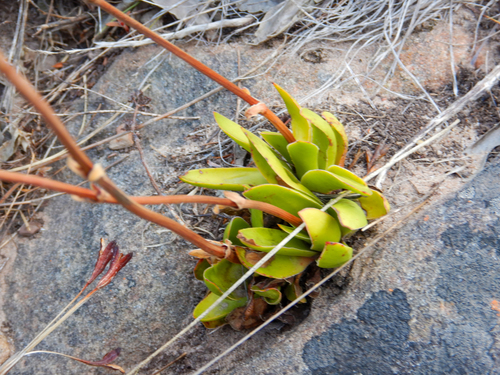
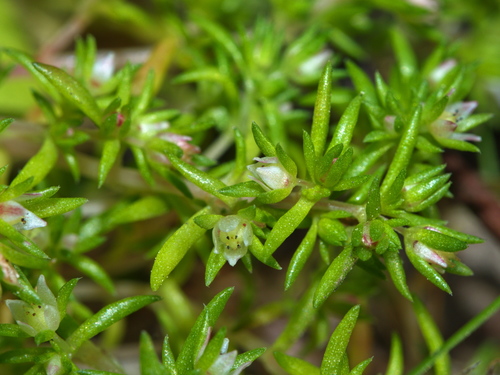
Crassula decumbens, commonly called rufous stonecrop, cape crassula, or spreading crassula, is a herb in the succulent family Crassulaceae. It is native to southern Australia, South Africa, and southern Chile, and has been introduced to other parts of the world. Two varieties of the species are generally accepted: Crassula decumbens var. decumbens and Crassula decumbens var. brachyphylla. This annual herb has a decumbent growth habit, or occasionally erect branches, that reach up to 15 centimetres (6 inches) in length. It blooms between July and October, producing flowers in cream, white, and pink shades. Its pointed leaves have a shape ranging from linear-lanceolate to oblanceolate; each leaf blade is typically 2.5 to 9 millimetres (0.10 to 0.35 inches) long and 0.4 to 1.5 millimetres (0.016 to 0.059 inches) wide. Its axillary flowers are four-merous, and on fruiting plants, the flower pedicels are longer than the sepals. The sepals are erect, lanceolate shaped, and have an obtuse apex. The brown, striate petals are shorter than the sepals, with a connate base and a hooded apex. The stamens have ovoid anthers. The species produces yellow, cylindrical-ovoid seeds. This species was first formally described by Swedish botanist Carl Thunberg in 1794 in his publication Prodromus Plantarum Capensium. Known synonyms for the species are Tillaea trichotoma and Bulliarda trichotoma. In Australia, it is commonly found on dune slopes in the Great Southern, Wheatbelt, Mid West, and Goldfields-Esperance regions of Western Australia, growing in clay-loam-sand mixed soils. It also grows across much of Victoria, southeastern South Australia, Tasmania, and New Zealand. In South Africa, it occurs throughout the Cape region.