About Crassula cotyledonis Thunb.
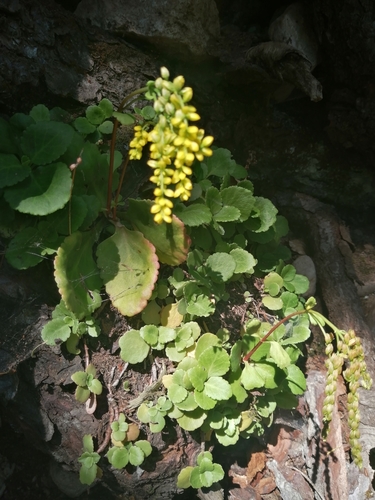
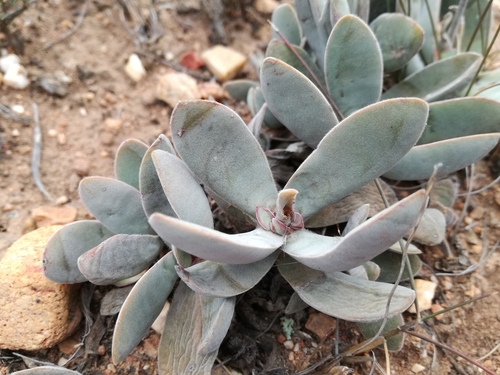
This plant grows as a low, sparse rosette. It has a short, tiny woody stem that lies against the ground. Its leaves are flattened and ovate, with a sickle or moon shape, and are typically light grey-green in colour. Leaf shape can range from narrowly ovate, for example in Karoo populations, to broadly ovate. The greyish leaves are pubescent, meaning they have a velvety texture, and the fine velvety hairs point backward. A line of short hairs also runs along the leaf margins. The tiny, closed-tubular, globular flowers have petals 2–3 mm long, and are arranged in rounded clusters along a long, elongated flower stem, with the peduncle measuring 8–15 cm. This species is closely related to Crassula nudicaulis, and resembles it in many characteristics. However, C. cotyledonis can always be distinguished by the cilia on the margins of the infertile bracts on the lower part of its peduncle, which are not arranged in a single row. The cilia on the leaf margins near the leaf tips are similarly irregular and not arranged in a single line. Other key identifying features are obovate or oblanceolate leaves with rough, backward-curved hairs, and an inflorescence with 3 to 6 infertile bracts near its base. This species occurs from Worcester, through the Karoo regions as far east as the Eastern Cape Province, and extends north as far as Namibia. It is most often found on upper hilltops and slopes, growing in very rocky ground and rocky outcrops.