About Crassostrea virginica (Gmelin, 1791)
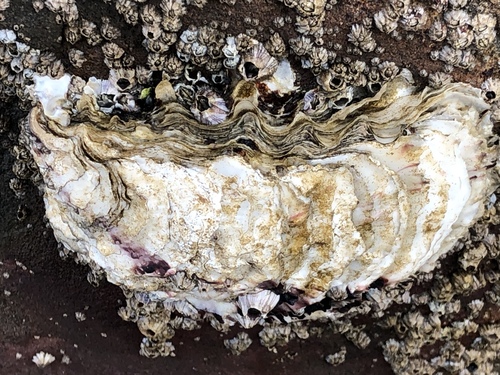
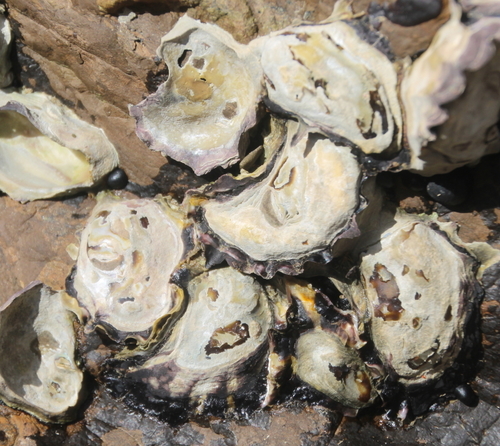
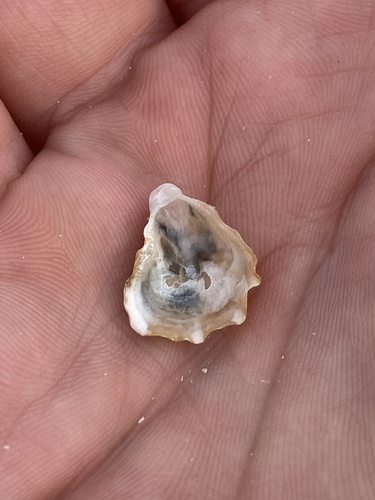
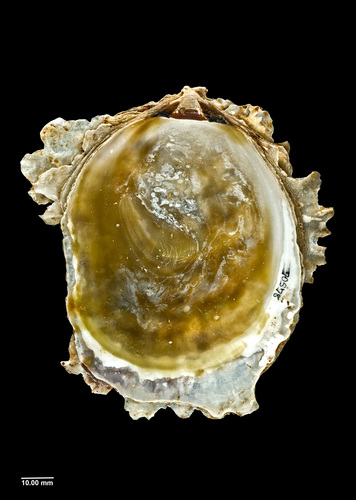
Crassostrea virginica, commonly called the eastern oyster, is a bivalve mollusc with a hard calcium carbonate shell that protects it from predators. Like all oysters, it is a filter feeder: it draws in water, filters out plankton and detritus to consume, then expels the filtered water back, cleaning the surrounding water in the process. A single eastern oyster can filter up to 50 gallons of water in a 24-hour period. Eastern oysters play a key role in their ecosystems, acting as foundation species and ecosystem engineers in western Atlantic estuaries. Like coral reefs, oyster beds (also called oyster reefs) create hard substrate for attachment and habitation, providing critical habitat for a wide variety of species. Oyster beds have an estimated 50 times more surface area than a flat bottom of the same size, and also attract a high concentration of larger predators searching for food. Like all members of the oyster family Ostreidae, C. virginica can produce small pearls to surround particles that enter its shell. These pearls are very small and hold no commercial value; the pearl oysters harvested for commercial pearls belong to a different family. Unlike most bivalves, which have aragonite shells, adult eastern oysters have calcite shells, though their larvae retain the ancestral aragonite shell structure. The two types of shell have similar specific gravity, so neither gives a weight advantage to free-swimming larvae. The shift to a thicker calcite shell in adult eastern oysters is thought to be an adaptation for defense against predators, since adult oysters are immobilized in exposed locations. The life cycle of C. virginica progresses through distinct stages: spawn, floating fertilized egg, trochophore, swimming straight-hinge veliger, swimming late veliger, swimming and crawling pediveliger, early spat, later spat, and finally adult oyster. Spawning in C. virginica is regulated by water temperature, and timing varies between northern and southern populations: northern oysters spawn when water temperatures are between 16 and 20 °C (60 and 68 °F), while southern oysters spawn at temperatures above 20 °C (68 °F). Spawning can occur throughout the warm months of the year. In southern waters, eastern oysters can reach sexual maturity as early as four months old. The reproductive cycle begins in late summer and autumn, when the oysters store glycogen as energy reserves. This glycogen is used to support gamete development during the next winter and early spring, when food availability is low. Gametes finish maturing in late spring, and are spawned into the water column between June and August, where fertilization takes place. Each female C. virginica produces between 75 and 150 million eggs, but only one out of every thousand eggs survives. Fertilized eggs develop into planktonic, free-swimming trochophore larvae (also called early umbo stage larvae) in approximately six hours. These larvae have cilia and a small shell, and rely on internal yolk reserves for energy. They develop into fully shelled veliger larvae (also called late umbo stage larvae) within 12 to 24 hours; these larvae have a hinged shell and a feeding/swimming structure called a velum. During this stage, the shelled veliger larvae use their ciliated vela to capture food and swim. Larvae stay planktonic for around 2 to 3 weeks, depending on food availability and temperature. Towards the end of this period, they develop into pediveliger larvae (also called eyed larvae), which have an umbo, an eyespot, and a foot. At this stage, pediveliger larvae settle to the bottom to search for a hard substrate to attach to. They prefer to settle on adult oyster shells, typically as part of an existing oyster reef, but will use other hard surfaces if needed. After settling, a larva cements its left valve to the substrate and undergoes metamorphosis into an oyster spat: it discards its velum, reabsorbs its foot, and enlarges its gills. During their first year of life, C. virginica are protandric. Most newly settled spat are male, but after reaching sexual maturity, some males change to female after their first or second spawning. Some females may even change back to males again later in life. C. virginica has been used in research to study oxidative DNA damage caused by environmental heat stress. Studies have found that heat shock-induced oxidative stress increases oxidative DNA damage (measured as 8-OHdG formation) and triggers cellular apoptosis (programmed cell death) in the gills of American oysters.