About Crassadoma gigantea (J.E.Gray, 1825)
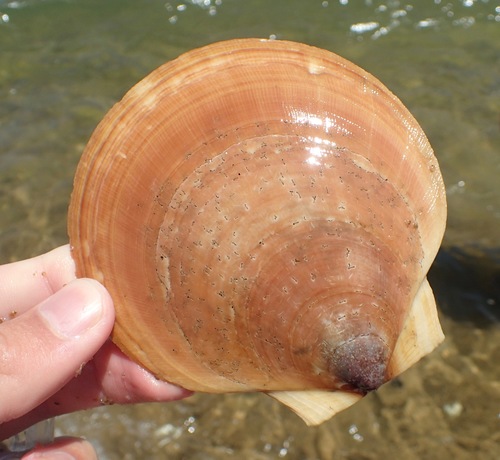
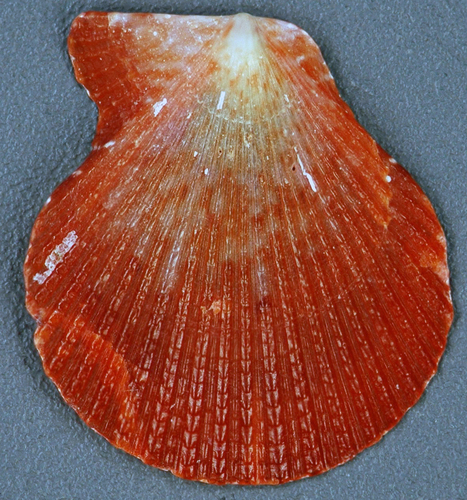
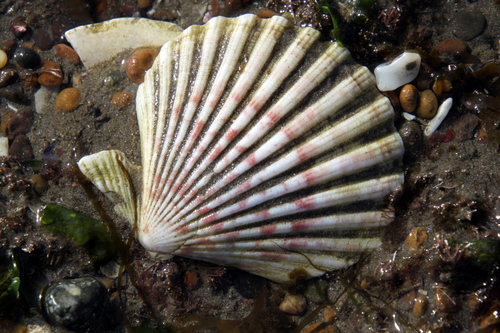
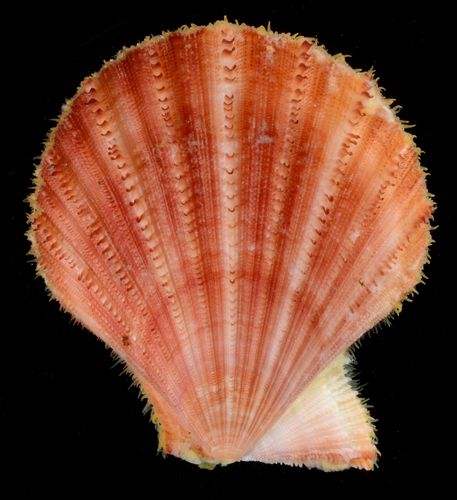
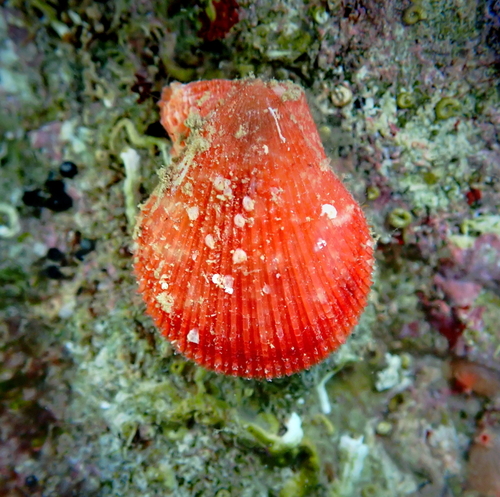
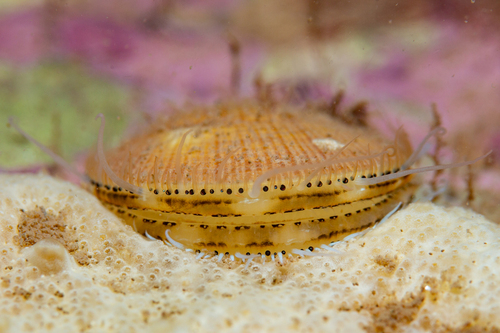
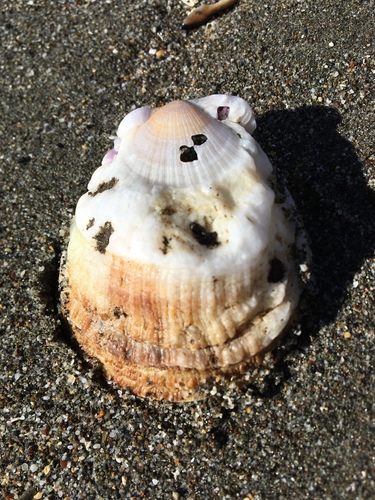
The scientific name of this species is Crassadoma gigantea (J.E.Gray, 1825). Adult Crassadoma gigantea have their right valve fixed to a base, most commonly a vertical rock face. This right valve often deforms to match the contours of the rock it attaches to. The left valve is roughly circular with an irregular outline, is thick and heavy, and bears deep radial ribs. Every third or fourth rib is covered with overlapping blunt spines. As the scallop ages, these spines often become abraded and worn smooth. On either side of the straight hinge, there are shell flaps called auricles. The overall shell colour is brown; the inside of the shell is glossy white with a purple patch at the hinge, and has a large, central adductor muscle scar. Crassadoma gigantea grows to 15 centimetres (5.9 in) in diameter in the intertidal zone, and reaches 25 centimetres (9.8 in) in diameter in the subtidal zone. Between the two valves, the margin of the orange mantle is visible, featuring a row of tiny blue eyes and a sparse fringe of short tentacles. This species occurs along the Pacific Coast of North America, ranging from southern British Columbia down to Baja California, Mexico. Adult Crassadoma gigantea are sessile and live on the sea floor. Its preferred habitats are inside crevices and under boulders, and it can also be cemented to rock surfaces, corals, or human-made structures such as harbour pilings. It can be found at depths down to approximately 80 metres (260 ft).