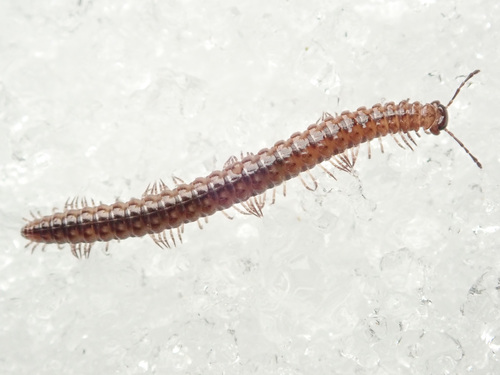
About Craspedosoma rawlinsii Leach, 1814
Adults of Craspedosoma rawlinsii Leach, 1814 range from 15 mm to 16 mm in length and 1.2 mm to 1.7 mm in width. The body is rich reddish brown, with a dark line down the middle of the back and narrow dorsal bands on either side, while areas around the paranota are light amber. Paranota are smoothly rounded lobes on the body sides, which give the body a rounded trapezoid shape in cross section. Each tergite has three pairs of setae. The ocelli are well developed and form roughly equilateral triangles. Like most species in the order Chordeumatida, adult C. rawlinsii have 30 segments (counting the collum, telson, and segments between), with 50 pairs of legs in females and 48 leg pairs in males. This count excludes leg pairs 8 and 9, which develop into gonopods in adult males. The anterior gonopods have a more distal element (telopodite) on each side, with the more basal coxal piece between them. The posterior gonopods have six processes projecting from a broad base. Variation in the size and shape of these processes within the species has led to the description of many subspecies and varieties from continental Europe. This millipede is widespread in Europe, and has been recorded in Austria, Belarus, Belgium, Bosnia and Herzegovina, Bulgaria, Croatia, the Czech Republic, Denmark, Estonia, Finland, France, Germany, Hungary, Ireland, Italy, Latvia, Lithuania, Luxembourg, the Netherlands, Norway, Poland, Romania, Russia, Serbia, Slovakia, Slovenia, Sweden, Switzerland, and the United Kingdom. It has also been introduced into Canada, and is the first species in the family Chordeumatida introduced into North America. In Canada, it has been recorded in Gatineau Park in Quebec, and in Cornhill and Grand Bay-Westfield in New Brunswick. In the British Isles, it is widespread but not common, rare in England, and recorded more frequently in Scotland and Ireland. In Europe, this millipede appears to be spreading to the northeast; it has been recorded relatively recently here, and is now widespread in Estonia and common in Latvia. In Russia, the first record outside Kaliningrad was from a park in Moscow, where the species was probably introduced. This millipede is found mainly in woodland, for example among Alnus, often in sandy soil, and favors high humidity. It is sometimes found in coniferous forests or more open habitats. In the British Isles, it is usually found in moist litter or under stones or bark, often near water or in another area that provides reliable moisture. In Switzerland, this millipede has been recorded at an elevation of 1,540 meters. The species can be found year round, but adults are usually found during the winter.

