About Craspedocephalus trigonocephalus (Donndorff, 1798)
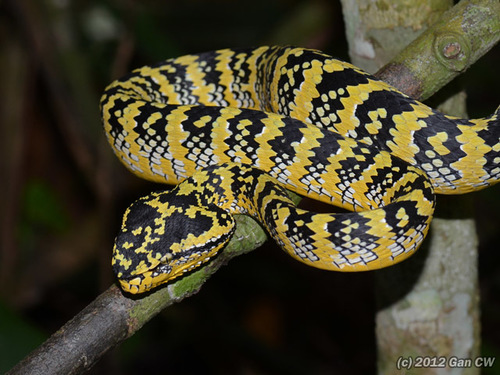
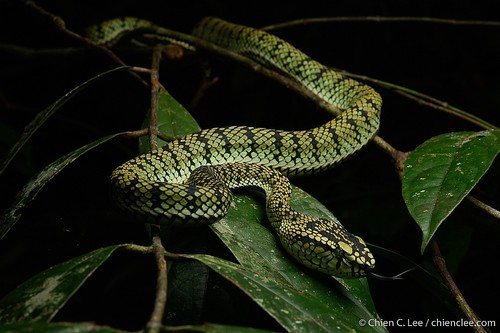
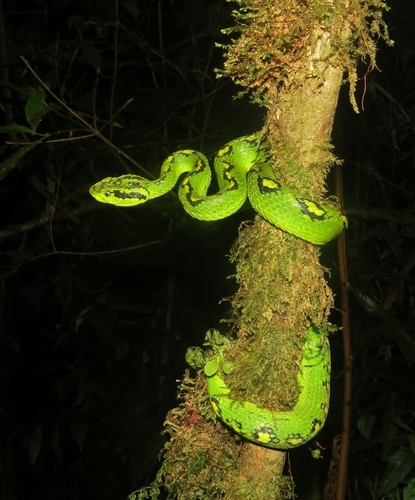
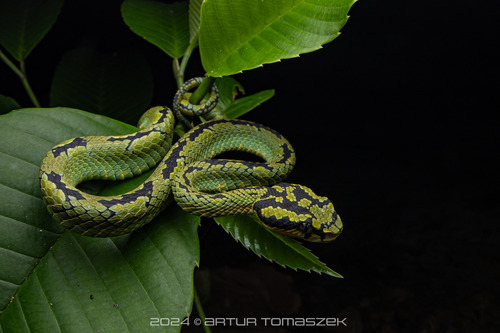
Craspedocephalus trigonocephalus is a mid-sized, sexually dimorphic snake species with a cylindrical body. Newborns of this species measure 20 to 25 cm (7.9 to 9.8 in) in total length. Males reach a maximum total length of 60 to 75 cm (24 to 30 in), and are considerably smaller than females, which can grow up to 130 cm (51 in) in total length. The neck of this snake is distinct from its flattened, triangular head, and a loreal pit is present on each side of the head. It has mid-sized eyes and a short, rounded, broad snout. This species has a variable, cryptic ground color. Most individuals are green with a black variegated pattern, and usually have a black temporal line; black patterns are more clearly defined on snakes from Sri Lanka's wet zone. The vertebral area has a slight yellow tinge, the tail is black, and ventral scales are light greenish-yellow or sometimes grey. Some individuals only have the black temporal line and black tail, with the rest of the body entirely green. Males typically have blue coloration, while females are predominantly green. Craspedocephalus trigonocephalus is a bulky arboreal species, with short, prehensile tails adapted for its tree-dwelling lifestyle. This species is endemic to Sri Lanka, and is widely distributed across all three of the island's climatic zones, except for higher hills and arid zones. It is relatively more common in wet zone grasslands and rain forest areas, and is occasionally found in cardamom, cocoa, coffee, and tea plantations. It occurs at lower altitudes ranging from 153 to 1,800 m (502 to 5,906 ft). The species' given type locality is "l'île S.-Eustache", which refers to Sri Lanka. There are no populations of this species on the Jaffna peninsula, and dry zone populations are currently under investigation as a possible separate species. Craspedocephalus trigonocephalus is viviparous, and produces between five and 25 young in a single birthing event.