About Craspedocephalus macrolepis Beddome, 1862
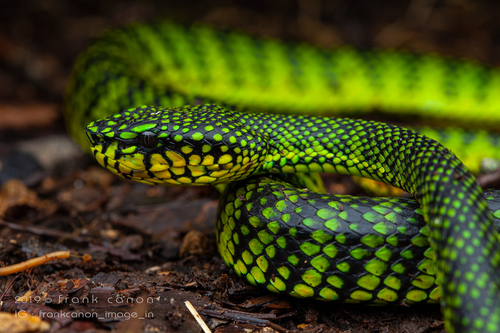
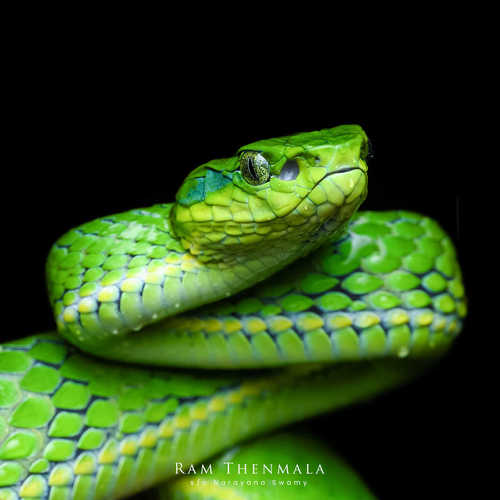
This species, Craspedocephalus macrolepis, was first described by Beddome in 1862. Adult individuals can reach a total length of 68 centimeters (27 inches), including a 12-centimeter (4.7-inch) tail. Dorsally, this species is bright green, with blackish skin visible between its scales in some areas. A yellow or white stripe runs along each side of the body, following the first dorsal scale row. The upper lips are pale green, and a black streak may be present behind the eye. Ventrally, the body is pale greenish in color. Dorsal scales are large, keeled, overlapping, and arranged in only 12 to 15 rows at midbody. Dorsal scales in the 10 middle rows are consistently the largest, while any additional rows are made up of smaller scales. An even number of dorsal scale rows is frequently seen in this species, a trait that is uncommon among snakes overall. This species has between 133 and 143 ventral scales, and 44 to 58 divided subcaudal scales. The scales covering the top of the head are very large, smooth, and overlapping. It has an elongated subocular scale, which is separated from the upper labials by a row of a few small scales. There are 7 to 8 upper labial scales, and the third of these is the largest. Craspedocephalus macrolepis is found in the mountains of the southern Western Ghats, located south of the Palakkad Gap in the Indian states of Kerala and Tamil Nadu. It is a high-elevation specialist, not normally recorded below 1200 meters above sea level. Confirmed records of the species come from Nelliyampathy, Munnar, Anaimalai, Palni hills, Meghamalai, Periyar Tiger Reserve, Agasthyamalai and Kalakkad Mundanthurai Tiger Reserve, at elevations ranging from 1200 to 2695 meters above sea level. Its type locality is listed as "Anamalai hills (Tamil Nadu State, southwestern India)". This is a slow-moving, arboreal, nocturnal snake. It prefers rainforest habitats, but is also found in tea, coffee and cardamom plantations. Craspedocephalus macrolepis is oviparous. Sexually mature females lay eggs in October, producing clutches of 4 to 7 eggs.