About Craspedacusta sowerbii Lankester, 1880
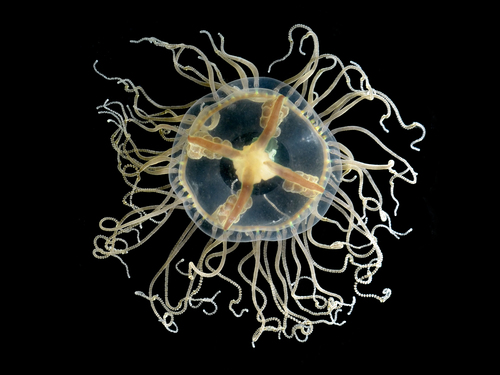
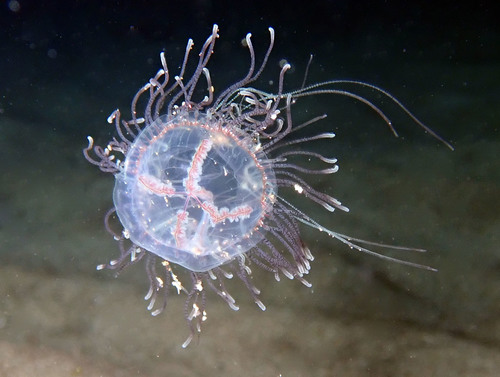
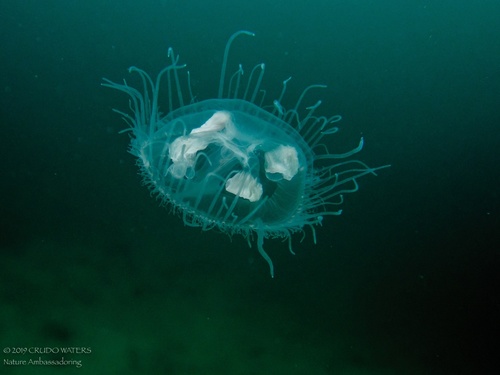
Craspedacusta sowerbii, commonly known as the peach blossom jellyfish or freshwater jellyfish, is a species of freshwater hydrozoan jellyfish, a hydromedusa cnidarian. Hydromedusan jellyfish can be distinguished from scyphozoan jellyfish by the presence of a muscular, shelf-like structure called a velum on their ventral surface, attached to the bell margin. This species is originally native to the Yangtze basin of China, and is now an introduced species found globally in freshwater bodies. It has been introduced to every continent except Antarctica. It typically inhabits calm freshwater environments including reservoirs, lakes, impoundments, gravel pits, and quarries. It has also been observed in slow-moving river backwaters, including the Allegheny River, Ohio River, and Tennessee River in the United States, and the Wang Thong River in Thailand. It is not typically found in fast-flowing streams or rivers. The annual appearance of the medusa form of this species is sporadic and unpredictable. It is not unusual for C. sowerbii to suddenly appear in large numbers in a body of water where it has never been recorded before, and these appearances are sometimes reported on local news. C. sowerbii starts its life cycle as a tiny polyp. Polyps live in colonies attached to underwater vegetation, rocks, or tree stumps, feeding and reproducing asexually during spring and summer. Some of these asexual offspring develop into sexually reproducing medusae. After fertilization, eggs develop into small ciliated larvae called planulae. Planulae then settle to the bottom of the water body and develop into new polyps. Most C. sowerbii populations in the United States are composed entirely of males or entirely of females, so sexual reproduction does not occur in these populations. During cold winter months, polyps contract and become dormant as resting bodies called podocysts. It is thought that podocysts are carried to other freshwater bodies by aquatic plants or animals. When environmental conditions become favorable again, podocysts develop back into polyps.