About Cranioleuca pallida (Wied-Neuwied, 1831)
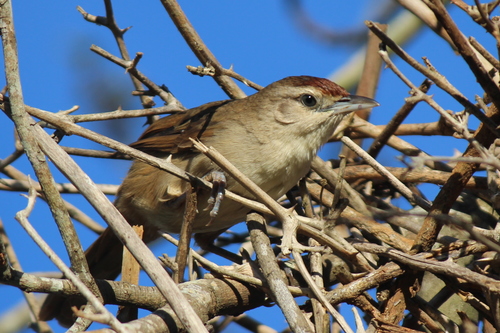
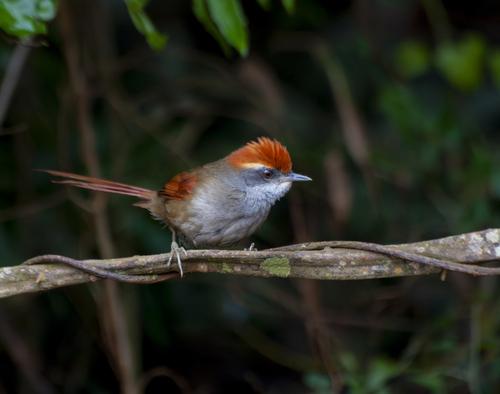
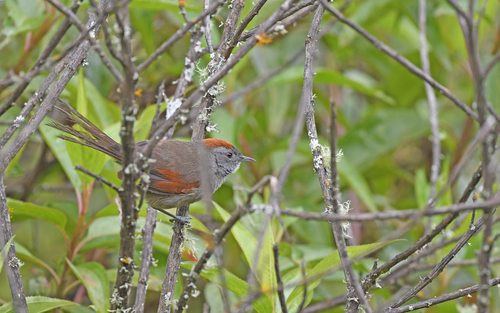
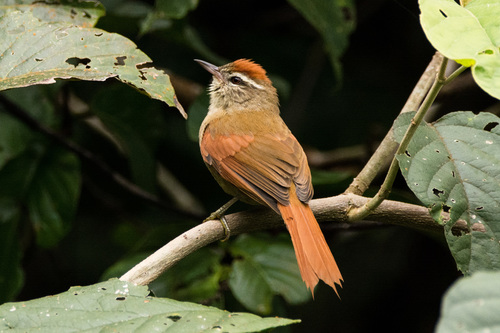
The pallid spinetail (Cranioleuca pallida) measures 14 to 15 cm (5.5 to 5.9 in) in length and weighs 11 to 12 g (0.39 to 0.42 oz). It is a smallish species in the genus Cranioleuca. Males and females have identical plumage. Adults have a wide whitish supercilium, a blackish spot in front of the eye, a dark brown band behind the eye, and buffy ear coverts marked with faint dark brownish streaks. Their forehead is streaked with blackish and buff; their crown is dark rufous, and their nape is gray. Their back and rump are tawny-olive or olive-brown. Their tail is dark rufous; the tail feathers are graduated and lack barbs at the tip, which gives the tail a spiky appearance. Their wing coverts are rufous, their primary coverts are dark brown, and their flight feathers are pale cinnamon-tawny to pale olive-tawny. Their chin is buffy whitish, their throat and breast are bright buffy to brownish olive, their belly is a duller pale brownish olive, and their flanks and undertail coverts are slightly darker. Their iris ranges from reddish brown to pale brown, their maxilla is black to dusky horn, their mandible is pinkish with a dusky tip, and their legs and feet are greenish olive or gray. Juveniles have a darker back than adults, along with a brown crown, ochraceous-tinged underparts, and variable dark mottling on the breast.
The pallid spinetail is distributed in southeastern Brazil, occurring from southern Goiás, central Minas Gerais, and southeastern Bahia southward into eastern Paraná. It inhabits montane evergreen forest, woodlands, and mature secondary forest, and occurs at elevations between 700 and 2,150 m (2,300 to 7,100 ft).