About Cranioleuca curtata (P.L.Sclater, 1870)
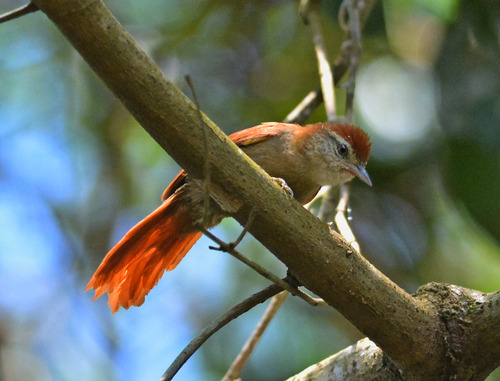
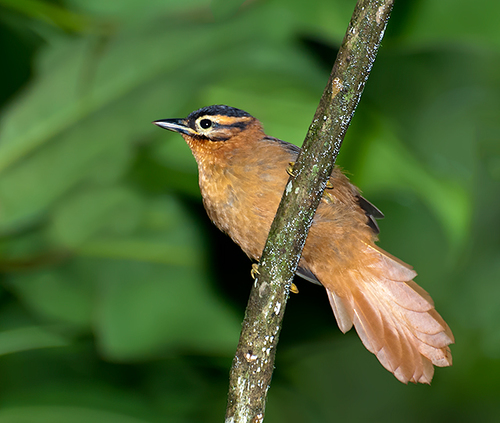
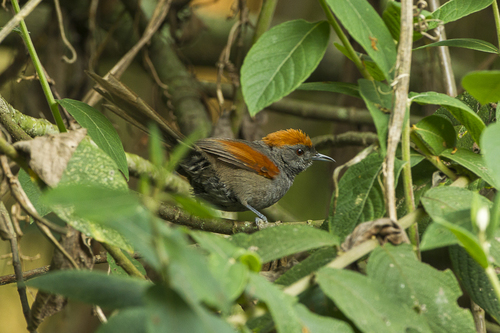
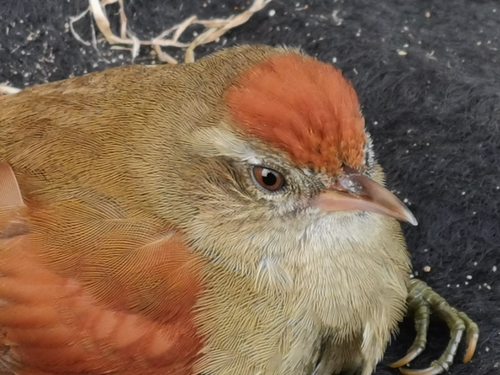
The ash-browed spinetail, Cranioleuca curtata (P.L.Sclater, 1870), is 14 to 15 cm (5.5 to 5.9 in) long and weighs 14 to 21 g (0.49 to 0.74 oz). Males and females have identical plumage. Adults of the nominate subspecies have a supercilium that ranges from bold whitish to an obscure dingy gray. The rest of their face is dull brownish, with some pale streaks on the ear coverts. Their forehead is brown with some reddish chestnut markings, their crown is solid reddish chestnut, and their back is rich brown that becomes increasingly reddish toward the uppertail coverts. Their wings are reddish chestnut; their flight feathers are slightly paler with dark fuscous tips. Their tail is dark reddish chestnut; the tail is graduated, and its feathers sometimes lack barbs at the tips. Their chin is very pale brownish gray, their throat is browner with light streaking, and their underparts are dull brownish with slightly richer brown flanks. Their iris is chestnut to brown, their maxilla is dark brown to blackish, their mandible is pinkish (usually with a dark tip), and their legs and feet are olive-greenish to mustard-yellow. Juveniles have a prominent supercilium, a mostly brown crown with some chestnut, and ochraceous rufous underparts. Subspecies C. c. cisandina has a darker, more chestnut-colored crown, wings, and tail than the nominate subspecies, and also has a darker brown back and darker grayish tones on its underparts. C. c. debilis is similar to C. c. cisandina but is overall paler, with a chestnut forehead. The nominate subspecies of ash-browed spinetail is the northernmost of the three recognized subspecies. It occurs on the west slope of Colombia's Eastern Andes, between the departments of Santander and Huila. Subspecies C. c. cisandina is found on the eastern slope of the Andes, from Caquetá Department in Colombia south through eastern Ecuador and into Peru, at least as far as the Department of Cuzco. C. c. debilis ranges from Peru's departments of Ayacucho and Cuzco south to Santa Cruz Department in Bolivia. This species inhabits humid foothill, lower subtropical, and montane evergreen forest. In elevation, it ranges between 800 and 2,300 m (2,600 and 7,500 ft) in Colombia, and mostly between 900 and 1,700 m (3,000 and 5,600 ft) in Ecuador, Peru, and Bolivia. It can be found locally as low as 650 m (2,100 ft) and as high as 2,500 m (8,200 ft).