About Crangon septemspinosa Say, 1818
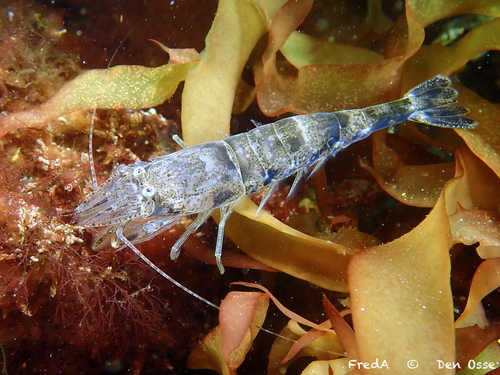
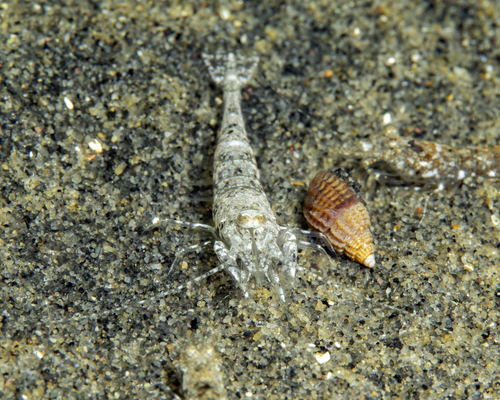
Crangon septemspinosa, commonly called sand shrimp, is a nocturnal species, meaning it is far more active in dark environments than in light ones. Its activity level is also higher in warm environments, a pattern reflected in an increased respiration rate. At 20 °C, this species exhibits a bimodal activity pattern, rather than a unimodal one. Sand shrimp serve as prey for many predators, and often face limited availability of their own prey. They are unspecialized feeders with an extremely diverse diet. When they follow a more active lifestyle, they can compensate by shifting their diet to a more carnivorous pattern, selectively consuming higher-energy animal tissues. This species has two major reproductive periods, though the timing of these periods varies by location. For populations in the Mystic River estuary, the two reproductive periods occur in early spring and late autumn. For populations in the Southern Gulf of St. Lawrence estuary, the main reproductive periods fall in spring and late summer, with lower levels of reproduction occurring around summer and early autumn. Southern Gulf of St. Lawrence estuary populations also have a more continuous reproductive period across spring and summer, rather than two separate spawning events in spring and autumn, meaning their reproductive cycle differs from that of more northerly populations. Overall, the mating season of Crangon septemspinosa changes based on the location and habitat of the population. In early spring, mature two- or three-year-old sand shrimp migrate from their usual offshore habitat into shallow shorelines, where they mate and reproduce. This migration acts as a recruitment mechanism in the life history of mature sand shrimp. On average, autumn reproductive periods produce around 1,600 eggs per individual. Spring reproductive periods produce the largest number of eggs, roughly twice the number produced in autumn.