About Crangon crangon (Linnaeus, 1758)
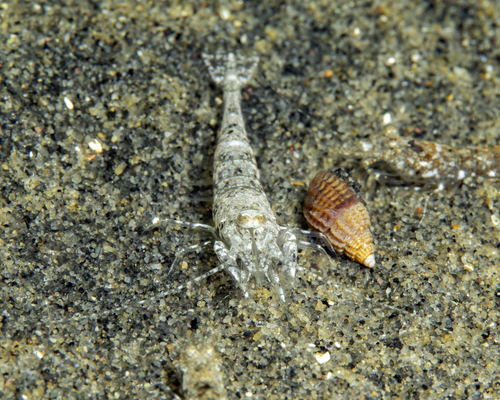
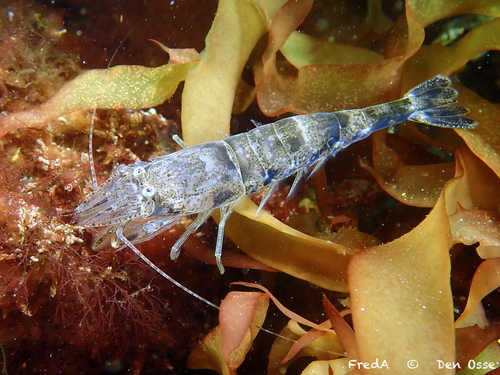
Adults of Crangon crangon are typically 30–50 mm (1.2–2.0 in) long, though individuals have been recorded reaching up to 90 mm (3.5 in). This species has cryptic, sandy brown colouration that can change to match its surrounding environment. It lives in shallow, sometimes slightly brackish water, and feeds only at night. During the day, it stays buried in sand to avoid predatory birds and fish, with only its antennae visible above the sand. Crangon crangon is classified in the family Crangonidae, and shares the family's characteristic traits: subchelate first pereiopods, where the movable finger closes onto a short projection instead of a similarly sized fixed finger, and a short rostrum. C. crangon has a wide distribution, spanning across the northeastern Atlantic Ocean from the White Sea off northern Russia to the coast of Morocco, including the Baltic Sea, and also occurs throughout the Mediterranean and Black Seas. Even with this broad range, little gene flow occurs between populations across certain natural barriers, such as the Strait of Gibraltar or the Bosphorus. Populations in the western Mediterranean Sea are thought to be the oldest, and the species' spread across the North Atlantic is thought to have occurred after the Pleistocene. Adults live epibenthically, on or near the sea floor, especially in shallow waters of estuaries or near the coast. It is generally highly abundant, and has a significant impact on the ecosystems it inhabits. Consumption of this species, commonly called brown shrimp, is popular in Belgium, the Netherlands, northern Germany, and Denmark. In Dutch, shrimp in general are called garnalen. This brown shrimp forms the base of the dish tomate-crevettes, where the shrimp are mixed with mayonnaise and fresh parsley, then served inside a hollowed-out uncooked tomato. Shrimp croquettes are another Belgian speciality made with this species; the shrimp are combined with béchamel sauce inside a battered croquette. Freshly cooked, unpeeled brown shrimp are often served as a snack to accompany beer, typically a sour ale or Flemish red such as Rodenbach. In Lancashire, England, peeled brown shrimp are mixed with butter and spices including nutmeg or mace to make potted shrimps, a dish traditionally eaten with bread.