About Cracticus torquatus (Latham, 1802)
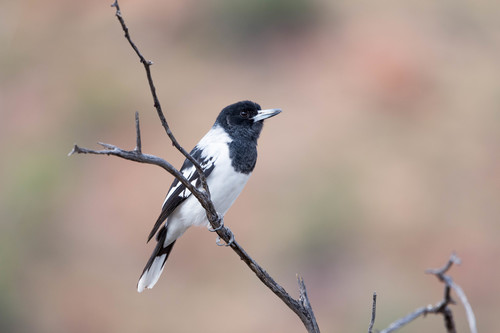
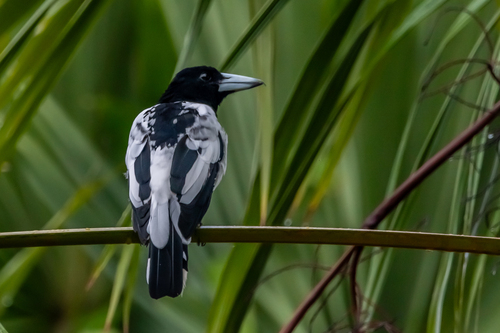
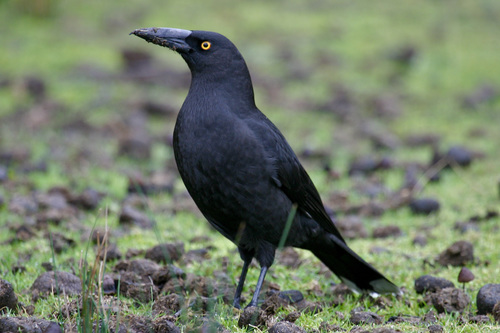
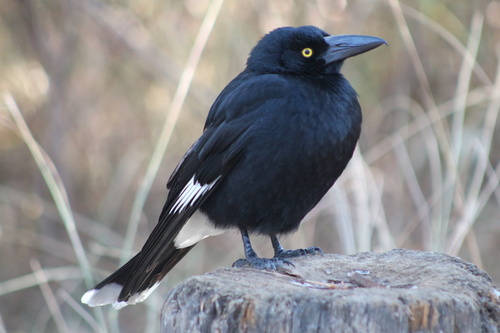
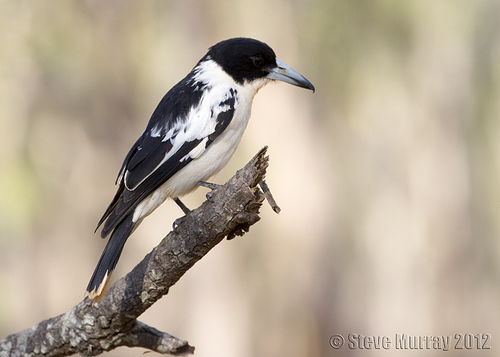
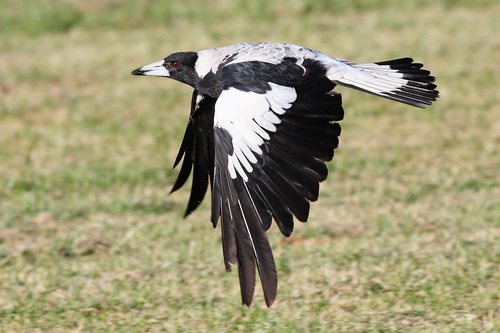
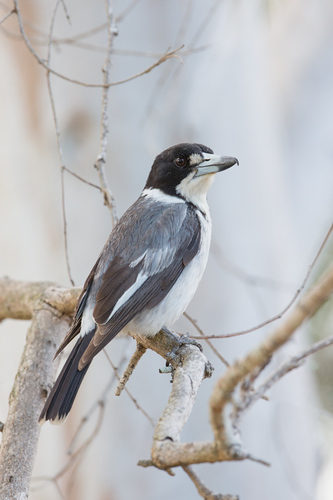
The grey butcherbird, with the scientific name Cracticus torquatus (Latham, 1802), is a small bird with grey, black, and white plumage. It averages 90 grams (3.2 ounces) in weight, has a body length between 27 and 30 cm (11 and 12 in), and a wingspan of 37–43 cm (15–17 in). It is smaller than the closely related pied butcherbird (Cracticus nigrogularis). Adult grey butcherbirds have black coloring covering the top, sides, and entire head, with a white chin, throat, and lower hindneck. Most of the upperbody is dark grey marked with narrow white streaks that stretch across the uppertail-coverts at the base of the tail. The uppertail is black with narrow white tips. The wings are grey with large white patches, and the underside of the wing is entirely white. The tip of the beak has a slight downward-facing hook. Males and females are similar in appearance, though females are slightly smaller. Juvenile grey butcherbirds differ from adults: they do not have a black head, instead having a dark brown head with fine streaks on the forehead and ear-covers, plus white loral spots that connect the eyes and bill, and an off-white chin and throat. Their upperbody is streaked dark brown, and their uppertail-coverts are also dark brown, with a brownish tone at the base of the uppertail. Juveniles have completely dark grey beaks, and the hooked tip of the beak is often not obvious. Juvenile grey butcherbirds are commonly mistaken for small kingfishers. Grey butcherbirds typically breed as single territorial pairs between July and January. Both sexes defend their territories and maintain nests throughout the year. Females incubate the eggs, while both parents feed nestlings and fledglings. Their nest is shallow and bowl-shaped, built from sticks and twigs, and lined with grasses and other soft fibers. Nests are usually placed within 10 m (33 ft) above the ground. This species occupies a wide range of habitats, including eucalypt forests and woodlands, mallee, acacia shrublands, rainforests, riparian vegetation, and urban and residential areas. In inland regions, the species favors denser forests.