About Cracticus nigrogularis (Gould, 1837)
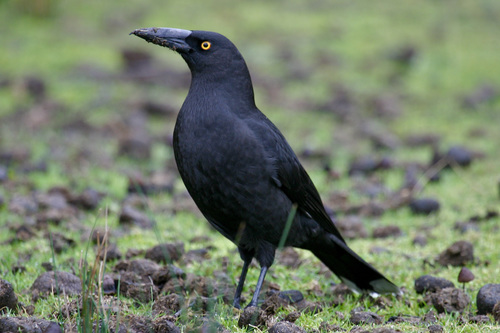
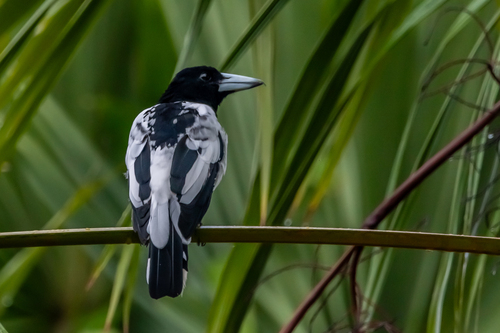
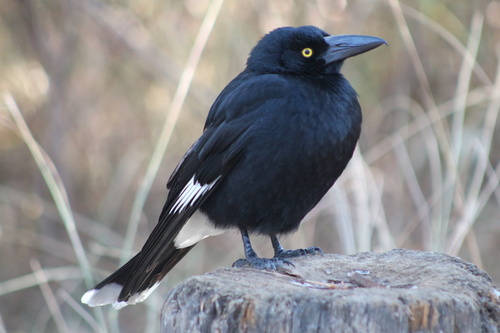
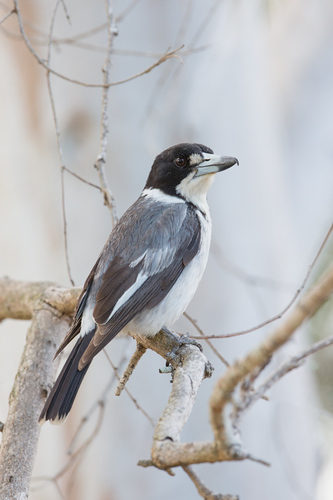
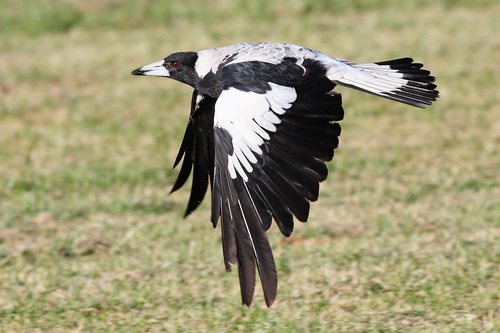
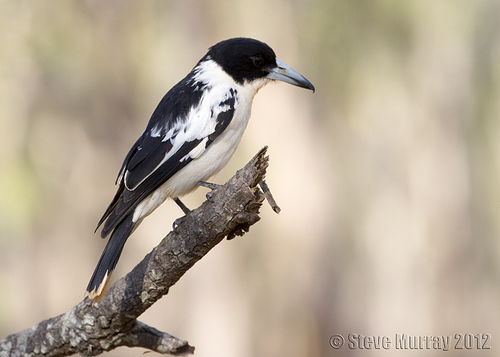
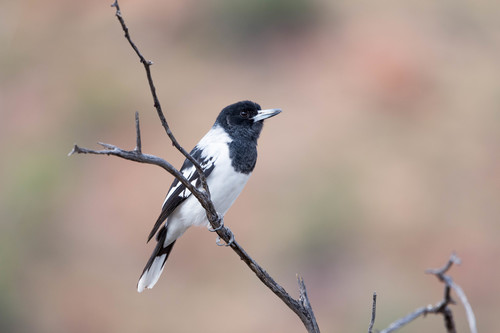
Like other butcherbirds, the pied butcherbird (Cracticus nigrogularis) is stockily built, with short legs and a relatively large head. It is 28 to 32 cm (11 to 12.5 in) long, averaging around 31 cm (12 in), with a 51 cm (20 in) wingspan and a weight of around 120 g (4 oz). Its wings are fairly long, reaching halfway along the tail when folded. Its plumage is almost entirely black and white, with very little difference between males and females. It has a black hood covering the head, nape, and throat, which is bounded by a 3.2 cm (1.2 in) wide white neck collar. The black hood has a slight gloss in bright light, can fade a little with age, and is duller and more brownish on adult females. Females also have a narrower neck collar at around 2.5 cm (1 in) wide, which is grey-white instead of white. Several stiff black bristles up to 1.5 cm (0.5 in) long grow from the lower lores. The upper mantle and a few front scapulars are white, contrasting sharply with the black lower mantle and the rest of the scapulars. The rump is pale grey, and the upper tail coverts are white. The tail is rather long, with a rounded or wedge-shaped tip, and has twelve black rectrices. The tail tip, outer wing feathers, and underparts are all white. The eyes are dark brown, the legs are grey, and the bill is pale bluish grey with a black tip and a prominent hook at the end. Juvenile pied butcherbirds have dark brown plumage instead of black, lack the pale collar, and have cream-to-buff lores, chin, and upper throat, with more brown colouring on the lower throat and breast. Juvenile underparts are off-white to cream, and the bill is dark brown. In its first year, it moults into first immature plumage, which resembles juvenile plumage but has a more extensive dark brown throat, and a blue-grey bill with a dark brown or blackish tip. The pied butcherbird is found across much of Australia, except for the far mainland south and Tasmania. It is only rarely recorded in the Sydney Basin, and absent from the Illawarra, Southern Tablelands, and south coast of New South Wales. In Victoria, it occurs along the Murray Valley and west of Chiltern. In South Australia, it is not found in the state's north-east or on the Adelaide plain. It occurs across Western Australia, though it is absent from the Great Sandy Desert. It is generally sedentary across most of its range, with minimal seasonal movement. It inhabits open sclerophyll forests, eucalypt and acacia woodlands, and scrublands with either sparse or no understory, or low cover with shrubs such as Triodia, Lomandra, or Hibbertia. It is less common in mallee scrub. In arid areas and northern Australia, it is more restricted to woodland alongside rivers and billabongs. It has become more common in south-west Western Australia with land clearing, and has become rare around Darwin due to urban development.