About Couesius plumbeus (Agassiz, 1850)
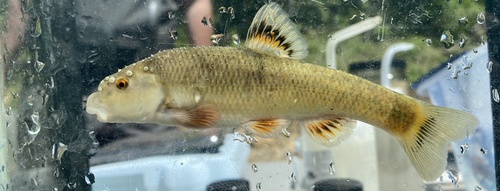
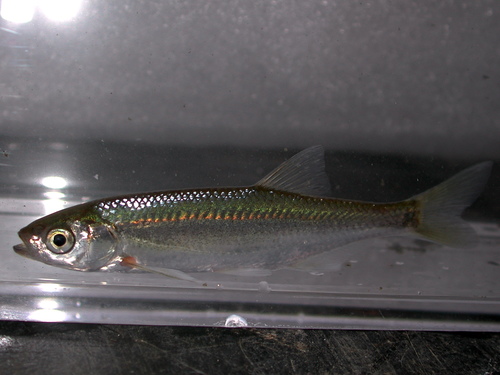
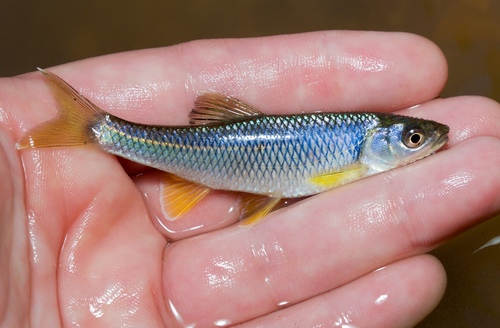
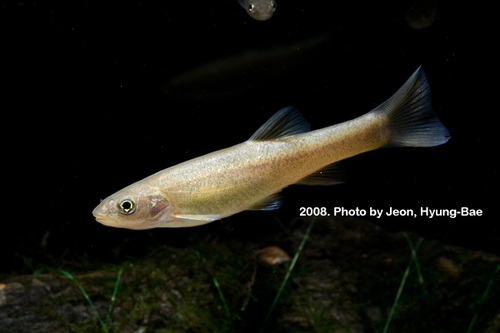
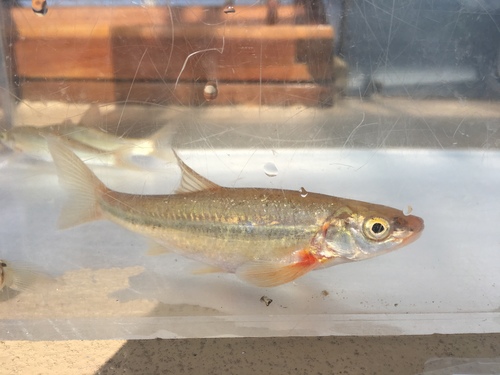
This fish, scientifically named Couesius plumbeus (Agassiz, 1850), has a fusiform, somewhat elongated body. Adults usually measure 100 to 175 mm (4 to 7 inches) in length, with a maximum recorded length of approximately 225 mm (9 inches). Its back is olive-brown or dark brown, and its sides are leaden silver — this coloration gives the species its scientific epithet plumbeus, which refers to lead. The snout is blunt and projects slightly past the upper lip, and a small barbel is present at each corner of the mouth. Its scales are small but clearly visible; some scales may be black, forming isolated dark spots on the lower sides. The dorsal, pelvic, and anal fins each have 8 rays. The broad pectoral fins have 13 to 18 rays, most often 15 to 16. This species has no teeth, no adipose fin, and no spines. It has a relatively small mouth and a forked tail. Breeding males develop bright orange or red patches at the base of their pectoral fins, and sometimes these colored patches also appear near the mouth. They also grow small nuptial tubercles on the top of the head, the dorsal surface of the pectoral fin rays, and on the belly near the base of the pectoral fins. Juveniles have a similar appearance to adults, but their mottling or striping is less obvious. Females are typically larger than males. The lake chub, as this species is commonly known, is widespread across Canada, reaching as far north as the Arctic Circle. Scattered populations also exist in the northern United States, specifically in New England, Michigan, Iowa, Wisconsin, Minnesota, the Dakotas, Montana, Wyoming, Colorado, Washington, Idaho, and Utah. It is the only minnow species confirmed to live in Alaska. Its distribution also includes Lake Michigan in Illinois and the Platte River system in Wyoming, and relict populations are found in the upper Missouri River drainage. As its common name suggests, the lake chub occurs most often in cold-water lakes with clean gravel, but it can also inhabit cold-water rivers and streams. It frequently lives in shallow waters, but may move to deeper parts of lakes during mid-summer to avoid the warmer shallow shore waters. Lake chub normally conduct spawning migrations in early summer. Water temperature influences when migration begins, and migrations are delayed in colder years. Migrating fish leave their resident lakes and rivers to ascend tributary streams, where spawning takes place day or night, and eggs are released over gravel or rock substrates. No parental care is provided for eggs or young. During migration, lake chub move mostly at dusk and during the night. When spawning, males pursue females. A spawning-ready male will charge a female, causing her to swim upward, sometimes breaking through the water surface. The male then swims alongside the female; if multiple males are present, they will swim alongside each other to compete for access to the female. During this interaction, the male opens and closes its mouth rapidly, until the female swims to a rock and the remaining male presses against her to trigger egg release.