About Coua cristata (Linnaeus, 1766)
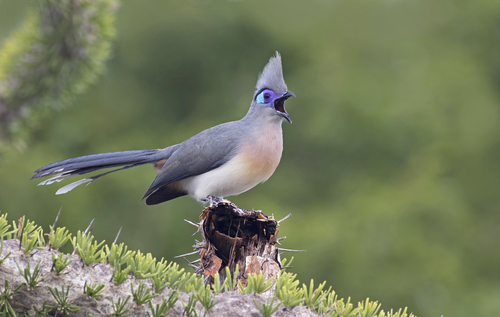
The crested coua, with the scientific name Coua cristata (Linnaeus, 1766), is a common medium-sized bird in the cuckoo family, Cuculidae. It is endemic to Madagascar, found primarily in the island's coastal regions. As a weak flyer, it is most often observed hopping between branches in high canopies. It is mainly distinguished by its greenish-grey back, prominent grey head crest, rufous breast, white abdomen, and bright turquoise and blue patches of bare skin surrounding the eyes. Crested couas are endemic to Madagascar and are the most widespread of all coua species. While their total population size is unknown, their estimated range covers 562,000 km² along the island's coast. They can be found at altitudes up to 900 meters above sea level, but are most common around 700 meters above sea level. They occur mostly in littoral and deciduous forests, but their habitat also includes open areas such as savannas and brushlands. They can occasionally be found in mangroves and palm stands. They typically avoid deciduous shrublands, and mostly select mosaics of forest and croplands. As an arboreal species, they tend to occupy forest layers above five meters, and nest on average around nine meters from the ground. Breeding crested couas usually occur in monogamous pairs. Unlike many other cuckoo species, crested couas do not practice brood parasitism. Instead, both the male and female co-parent their chicks. The pair builds its own nest from twigs, and hides the nest in trees or bushes to avoid detection by predators. The female lays two white eggs, which are incubated by both parents. Chicks hatch altricial, and both parents equally contribute to raising the young until they fledge the nest at around two weeks old. Couas have low fecundity, but adults have high longevity, reaching up to 15 years in captivity, which allows them to support a smaller brood size. Because their young-rearing period is short, crested couas can produce multiple clutches in a single breeding season, which runs from September to March.