About Cotyledon orbiculata L.
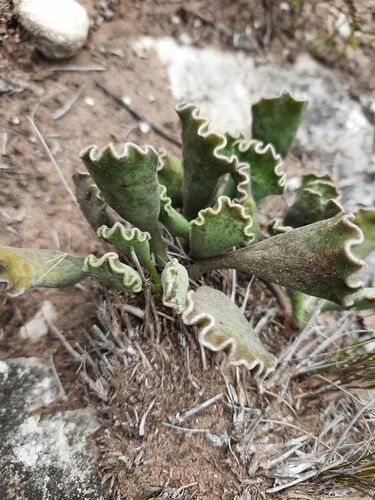
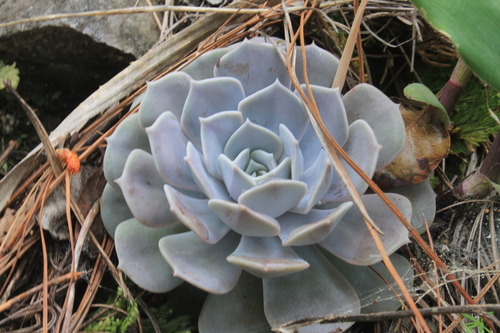
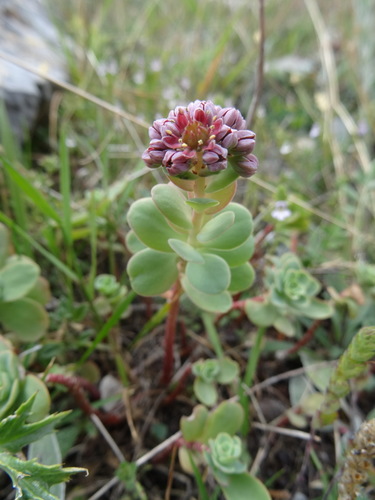
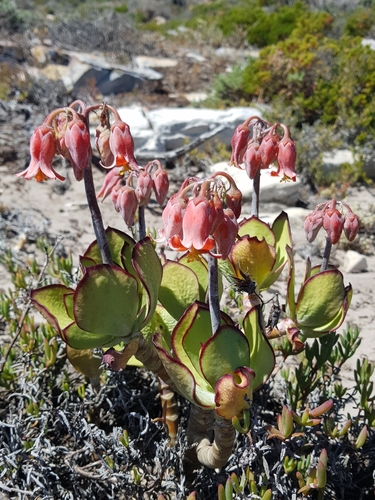
Cotyledon orbiculata L. is a highly variable succulent species that grows to about 1.3 meters (4.3 feet) in height. It produces gray-green leaves that can reach up to 13 by 7 centimeters (5.1 by 2.8 inches) in size. A white powdery substance called farina naturally forms on leaf surfaces; this farina helps reflect sunlight and conserve water. If any area of a leaf is brushed against or even gently disturbed, the farina will become noticeably smudged. This powdery coating does not regenerate after being disturbed or wiped off, but this damage is normally not detrimental to the plant and very rarely results in an unsightly appearance. Most succulent plants eventually lose their older leaves and grow new ones to replace them over time. Ironically, water in forms including dew, marine layer fog, mist, rain, and even garden hose or hand watering does not appear to wash farina off, and farina reappears as leaves dry. The species got its common name pig's ear because its leaf shape was thought to resemble a pig's ear. Its bell-shaped flowers bloom in winter, and are typically blood orange-red or paler salmon-orange, though yellow varieties also exist. To an untrained observer, these blossoms may look similar to the flowers of the distantly related African genus Kalanchoe. However, Cotyledon orbiculata produces small tubular upside-down bells that are usually less than 3 centimeters (1.2 inches) long, and it tends to produce flowers in denser clusters than Kalanchoe. The flowers hang and droop from the top of a 60 centimeter (24 inch) tall stalk. The tubular corolla has no bulges, is approximately 20 millimeters long, and can be up to 9 millimeters in diameter. The bent, backward-pointing corolla tips are orange, red, or yellow, and measure 12 millimeters long. Stamens protrude 2 to 3 millimeters out from the flower. The yellow anthers are elongated and approximately 1.75 millimeters in diameter. The semi-transversely elongated nectar scales are dull yellowish-green, and measure 1.5 × 2 millimeters. The 10 stamens attach to the base of the corolla, with 2 stamens per petal, and each of the 5 carpels has a style that is longer than its ovary. This species is native to South Africa, and it is popular for garden cultivation in many countries. In the wild, it grows naturally on rocky outcrops in grassy shrubland and the Karoo region. In New Zealand, it is considered an invasive plant and is listed on the National Pest Plant Accord. Cotyledon orbiculata has multiple medicinal uses. In South Africa, the fleshy interior of the leaf is applied externally to warts and corns. Heated leaves are used as poultices to treat boils and other inflammations. Single leaves may be eaten to act as a vermifuge, and leaf juice has been used to treat epilepsy. However, the leaves contain a bufanolide called cotyledontoxin, which is toxic to sheep, goats, horses, cattle, poultry, and dogs, causing a condition known as cotyledonosis.