About Coturnix japonica Temminck & Schlegel, 1848
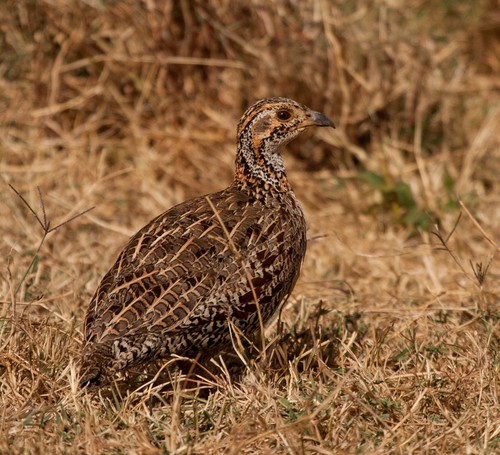
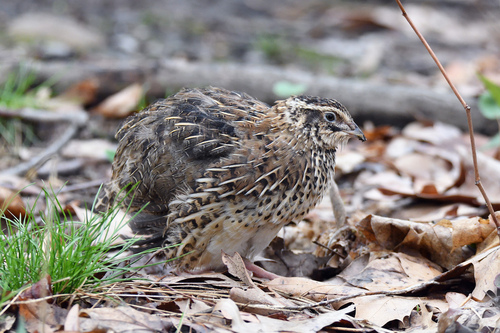
Coturnix japonica, the Japanese quail, shows morphological differences across its life stages. Newly hatched chicks of both sexes have identical plumage and coloration: their heads are tawny, with small black patches scattered above the beak. The wings and back are pale brown, and four brown stripes run lengthwise along the back. A pale yellow-brown stripe runs down the top of the head, bordered by smaller black stripes. Adult Japanese quail have sexually dimorphic plumage that allows easy sex distinction. Both adult sexes have predominantly brown plumage, but throat and breast markings and the exact shade of brown vary significantly. Female breast feathers are generally pale with scattered dark spots, while male breast feathers are a uniform dark reddish-brown with no dark spots. This reddish-brown color also appears on male cheeks; female cheek feathers are cream-colored. Some males develop a white collar, which never occurs in females of the species. Note that this typical coloration applies to wild populations of Coturnix japonica. Domestication and selective breeding have produced many different strains with a wide range of plumage colors and patterns. Most domestic strains remain sexually dimorphic, but some cannot be distinguished by plumage coloration, including the Texas A&M, English white, and tuxedo strains. Males are generally smaller than females. Wild adult Japanese quail weigh between 90 and 100 grams, while most domesticated adults weigh between 100 and 120 grams. Weight varies considerably across domestic lines: commercial meat-bred strains can weigh up to 300 grams. Compared to the common quail, Japanese quail have darker, more contrasting upperparts and deeper rufous underparts. In the breeding season, male Japanese quail have distinctive rufous throat feathers, which are replaced by long pale feathers in the non-breeding season; this plumage trait is not seen in the common quail. Japanese quail populations mainly inhabit East Asia and Russia, including India, Korea, Japan, and China. Most populations migrate south to winter in areas like Vietnam, Cambodia, Laos, and southern China, though a number of resident populations overwinter in Japan. The species is also found across many parts of Africa, including Tanzania, Malawi, Kenya, Namibia, Madagascar, and the Nile River Valley from Kenya to Egypt. Breeding sites are mostly concentrated in East and Central Asia, including Manchuria, southeastern Siberia, northern Japan, and the Korean Peninsula. The species has also been observed breeding in some regions of Europe and in Turkey. Japanese quail are primarily ground-dwelling birds that stay in dense vegetation to take cover and avoid predators. Their natural habitats include grassy fields, bushes along river banks, and agricultural fields planted with crops like oats, rice, and barley. They prefer open habitats such as steppes, meadows, and mountain slopes near a water source. Japanese quail were long thought to have an underdeveloped sense of taste, as they could not distinguish between different types of carbohydrates, but later research confirms they do have a limited ability to taste. Evidence for this includes their preference for sucrose-containing solutions over plain distilled water, and their avoidance of salty solutions. While Japanese quail have an olfactory epithelium, little is known about their sense of smell. Still, some studies show they can detect certain substances using smell alone: for example, they can detect certain pesticides, and avoid food that contains toxic proteins called lectin, using only their sense of smell. Through nasolateral movement of the eyes, Japanese quail achieve frontal overlap of their visual fields. Long-distance perception uses binocular field accommodation. To maintain focus on an object while walking, the quail makes matching head movements. Japanese quail also have color vision, with better color perception than form or shape perception. Little is known about hearing in Coturnix japonica, but the species can distinguish between different human phonetic categories. Japanese quail are frequent dust bathers, and individuals complete multiple dust bathing sessions each day. To dust bathe, the bird rakes the ground with its bill and legs to loosen soil, then uses its wings to toss dust into the air. As dust falls back down around the bird, it shakes its body and ruffles its feathers to coat all feathers thoroughly. This behavior is thought to support feather maintenance and remove parasites.