About Coturnicops noveboracensis (Gmelin, 1789)
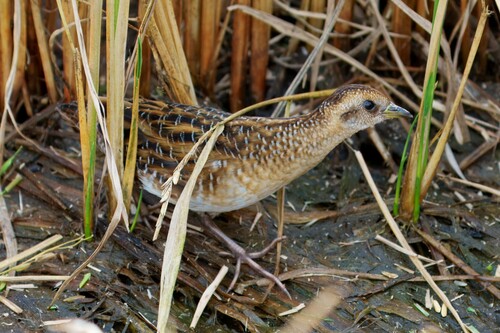
Adults of Coturnicops noveboracensis, the yellow rail, have brown upperparts streaked with black, a yellowish-brown breast, a light belly, and barred flanks. Their back feathers are edged with white, they have a yellow-brown band over the eye, and their legs are greenish-yellow. They have a short, thick, dark bill, which turns yellow on breeding males. The species measures 16–19 cm (6.3–7.5 in) in total length, with males averaging 59 g (2.1 oz) and females averaging 52 g (1.8 oz) in weight.
Two subspecies are recognized. The nominate subspecies breeds in wet meadows, fens, and shallow marshes across Canada east of the Rocky Mountains, as well as in the northeastern United States and along the entire Canada–United States border from the Great Plains to the Great Lakes. Northern populations of this subspecies migrate to the southeastern coastal United States for winter. Little is known about the yellow rail's winter habits beyond observations at sites in coastal Texas, southeast Oklahoma, and coastal South Carolina. Observational studies have found that the relative abundance of overwintering yellow rails increases with the size of the surveyed area, and is higher at sites that were burned within the past 3 years. Each additional hour of survey effort across sites increased the number of detected birds by 0.66 rails per hour. These findings indicate that yellow rails overwinter in wet pine savanna habitats of the northern Gulf Coast region. The subspecies Coturnicops noveboracensis goldmani is only known from marshes on the upper Río Lerma (Lerma River) at around 2,500 m elevation in the State of Mexico, Mexico, and it was last recorded there in 1964.
Yellow rails feed primarily on small invertebrates, and supplement their diet with plant seeds. Beetles (Coleoptera) make up the largest portion of their diet, followed by spiders (Araneae) and snails (Gastropods). Among the plant matter they consume, sedges (Cyperaceae) and rushes (Juncaceae) are dominant.