About Cottus rhotheus (Smith, 1882)
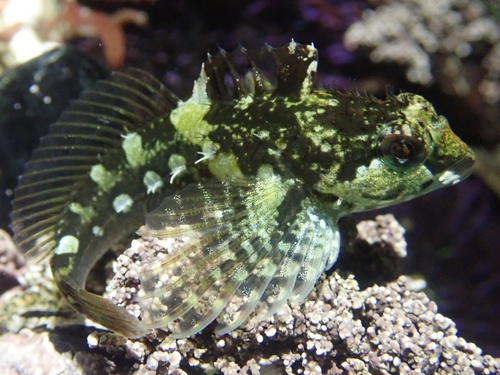
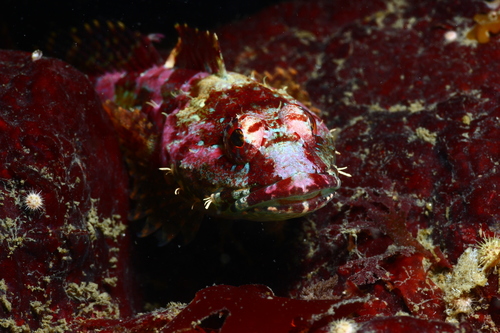
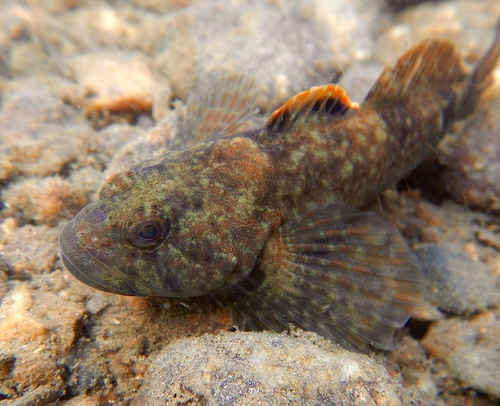
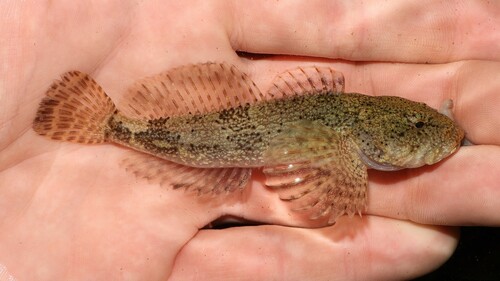
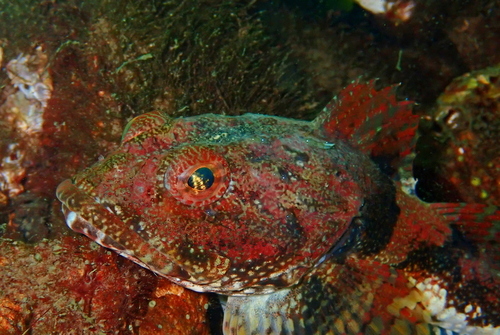
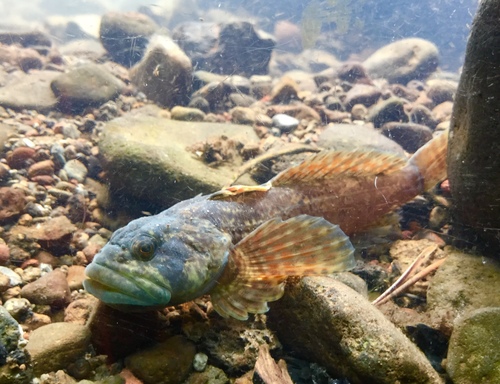
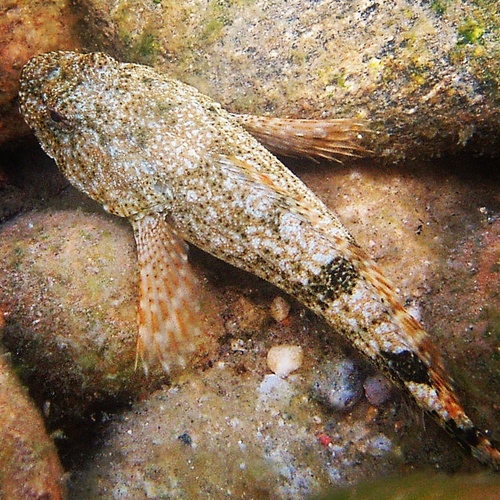
The torrent sculpin, scientifically named Cottus rhotheus, is generally grey-brown with black speckling. A soft orange color occurs on the ventral body between its pectoral fins, and the entire ventral side is also speckled. Dark bands form near the dorsal fin, caudal fin, and anal fin, and the speckling may form a faint band near the pectoral fins. In males, the dorsal fin is orange, and its base may be darker in color. This species has two sharp dorsal fins, a heavily mottled chin with two pores on its top surface, and a subterminal mouth. Three sharp spines are located on the preoperculum. Very rigid, strong prickles grow on the head, near the dorsal fins, on the dorsal side of the caudal peduncle, and around the anal fin, though this feature may be reduced in some individuals. On average, adult torrent sculpins measure over 45 mm in total length, with the species ranging from 50 mm to 150 mm overall; juveniles measure between 35 mm and 45 mm. The species has a relatively large gape: a large adult can have a 5.7 mm wide mouth at a total body length of 42 mm. Narrow bands of teeth line both the upper and lower jaw, and strong palatine and vomerine teeth are also present. C. rhotheus shows geographic variation in head length, lateral line length, prickle presence, and caudal vertebrae size. Populations in British Columbia have larger caudal vertebrae than populations in Oregon. Populations in Washington and Oregon have absent or significantly reduced prickles, shorter heads, and shorter lateral lines than populations in British Columbia. There are no noticeable differences between sexes in the number of dorsal spines, dorsal rays, anal rays, or the size of caudal vertebrae; mature females can be distinguished by their extended abdomens. C. rhotheus is a widespread, abundant bottom-dwelling fish. It is most commonly found in the Columbia River Basin, covering parts of British Columbia, Washington, Idaho, Montana, and Oregon. It also inhabits the upper Fraser River system in British Columbia, the Nehalem River coastal drainage system in Oregon, and the Puget Sound coastal drainage system in Washington. The species occupies a wide range of habitats, most commonly lotic water systems including medium to large streams, and can also be found in lakes in more northern areas. Its distribution is patchy within the Lake Washington basin, where four other sculpin species occur in higher numbers; the basin as a whole holds 25 native fish species and 20 introduced fish species. Non-native introduced species increase competition and predation pressure on C. rhotheus, reducing their population numbers. Within the Cedar River, C. rhotheus is the most abundant sculpin species. It has a cold-water-adapted physiology that lets it survive in Pacific Northwest streams that cannot support most other fish species.