About Cottus gobio Linnaeus, 1758
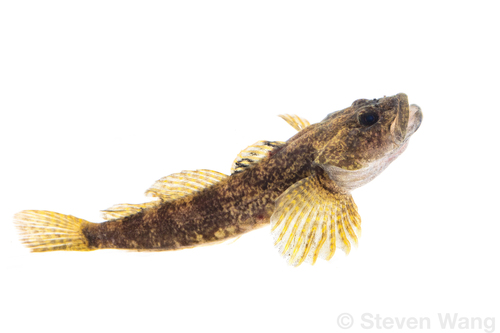
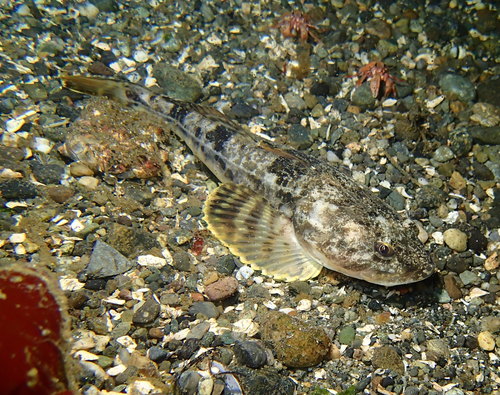
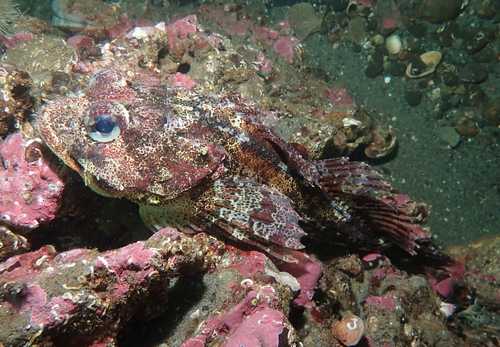
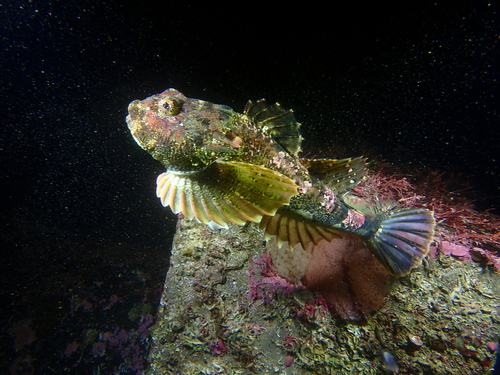
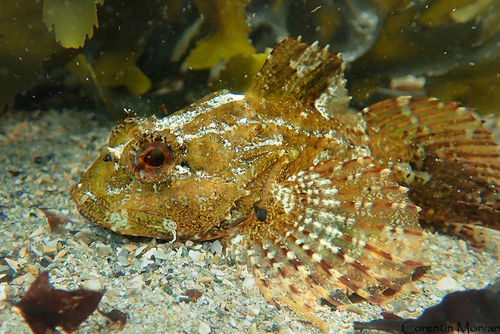
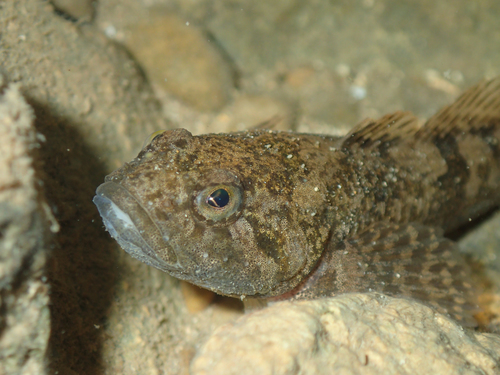
This species is commonly known as the bullhead, or European bullhead, with the scientific name Cottus gobio Linnaeus, 1758. The bullhead has a large, broad head, a tapering body, large fins, and a rounded tail. Its eyes are positioned near the top of the head. It can be distinguished from other Northern European freshwater sculpin species: compared to the alpine bullhead Cottus poecilopus, all rays of the bullhead’s pelvic fins are similar in length, while in the alpine bullhead the first and last rays are longer. The bullhead’s pelvic fins are also colourless, and lack the stripes present on the alpine bullhead’s pelvic fins. It can be told apart from the fourhorn sculpin because the bullhead’s dorsal and anal fins end close to the tail, creating a short caudal peduncle. When the bullhead rests on the bottom, its pectoral fins flare out to look like wings. Most bullheads measure around 6 to 8 cm (2.4 to 3.1 in) long, and are light brown with darker mottled colouring. As currently treated, the European bullhead is widespread across most of Europe and the United Kingdom, but is absent from southern European peninsulas and Northern Scandinavia. This group is not a single uniform taxon; instead it is made up of morphologically and genetically distinct subunits. Some of these subunits were classified long ago as separate subspecies or species with their own names, but in practice most have still been treated as part of the broader Cottus gobio concept. In 2005, Freyhof et al. proposed splitting European Cottus gobio into fourteen distinct species. Six of these had been described previously, and eight were newly described and named. The fourteen species are: Cottus aturi, found in the Adour basin of France; Cottus duranii, found in upper Dordogne, Loire and other locations in France; Cottus gobio sensu stricto, found in Germany, Sweden, and Central Europe; Cottus haemusi, found in the Beli Vit river of the Danube basin in Bulgaria; Cottus hispaniolensis, found in the Garonne basin of France and Spain; Cottus koshewnikowi, found in Northeast Europe; Cottus metae, found in the Sava river of the Danube drainage; Cottus microstomus, found in East Central Europe including Poland, Slovakia, and Ukraine; Cottus perifretum, found in Great Britain, Netherlands, Germany, and France; Cottus petiti, found in the Lez river of France; Cottus rhenanus, found in Netherlands and Germany; Cottus rondeleti, found in the Hérault basin of France; Cottus scaturigo, found locally in Trieste, Italy; and Cottus transsilvaniae, found in the Argeș river of the Danube basin in Romania. Additionally, the taxon Cottus ferrugineus is reported to occur in Italy and the Balkans, but this classification is considered invalid. Under this 2005 split, British bullheads are classified as Cottus perifretum. However, common usage in the UK, especially among conservation authorities, still mostly treats British bullheads as Cottus gobio.