About Cottus cognatus Richardson, 1836
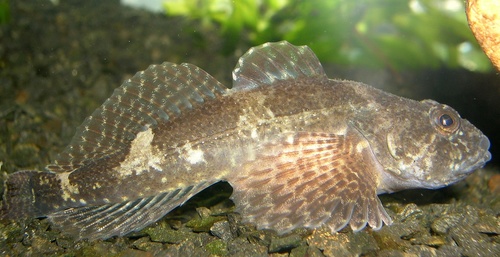
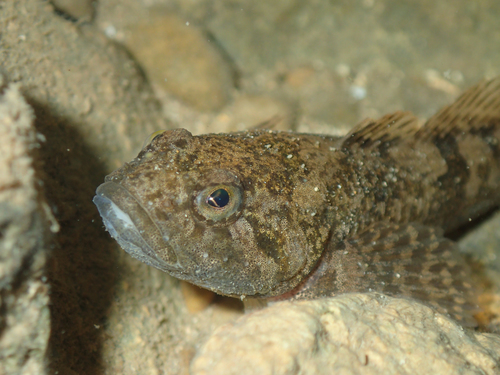
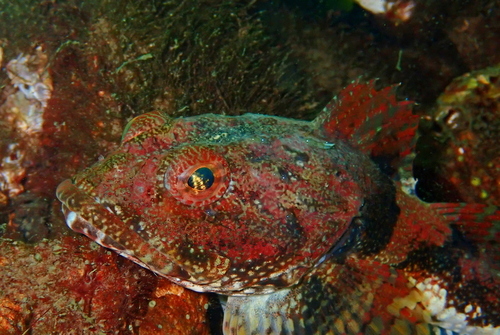
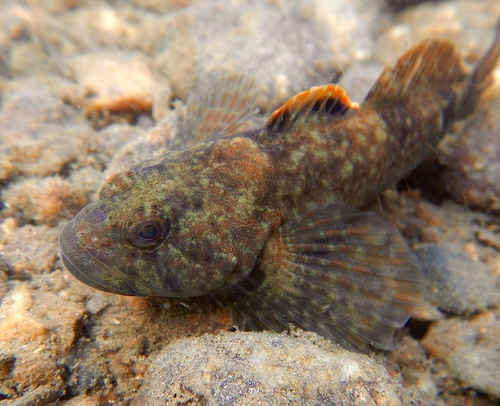
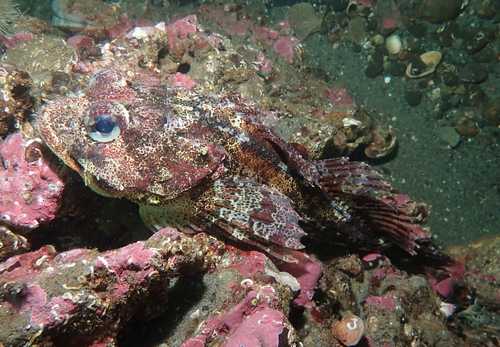
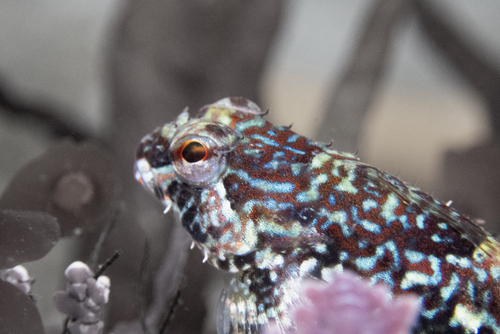
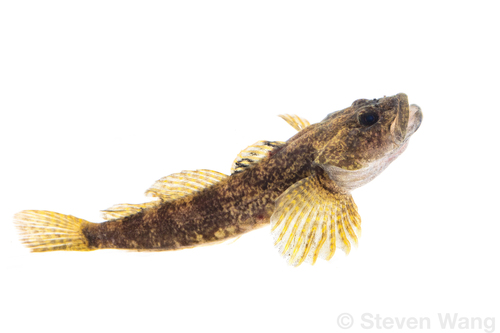
Cottus cognatus, commonly known as the slimy sculpin, can be easily distinguished by its pair of free, independent pelvic fins and complete lack of scales. It has two narrow, lobed dorsal fins that touch one another: the first dorsal fin holds 7–9 soft spines, while the second has 16–18 fin rays. Its incomplete lateral line ends below the second dorsal fin; the lateral line system still helps the fish orient itself in streams by balancing current pressure. The anal fin has 11–13 fin rays, and the pelvic fins, which hold 13–14 fin rays, sit in the thoracic position. The fish has a very wide, terminal mouth and snout, with a band of fine conical teeth on both upper and lower jaws, and no barbels. Adult slimy sculpins typically weigh 3–7 g (0.11–0.25 oz) and measure 6.3–9.1 cm (2.5–3.6 in) long. The maximum recorded weight for the species is 16.86 g (0.595 oz), and the maximum recorded length is 12.8 cm (5.0 in). Due to its irregular compressed body shape, the slimy sculpin moves with inconsistent, rapid darter-like motion that resembles hopping. Its head, back and sides are dark brown or olive, mottled with dark irregular blotches, and it has a light cream or white belly. When motionless, the fish camouflages so well with its surroundings that it is almost impossible to spot. Though it has no scales, it does have a small number of fine prickles on the anterior body below the lateral line. It often looks very similar to the tubenose goby. Slimy sculpins are native to the United States, Canada, and the Russian Federation. In North America, they are found mainly in Lake Superior and its tributaries, Lake Michigan, small cold streams in southwestern Wisconsin, and the upper Mississippi River basin. They also occur across other areas of North America, including southeast Minnesota (mostly in the Mississippi River), northeast Iowa, the upper Columbia River, Alaska, and nearly all of Canada. Populations are also found in eastern Siberia, Russia. Slimy sculpins most often inhabit swift, rocky-bottomed cold streams, oligotrophic lakes, and even brackish waters, with a preferred temperature range of 9–14 °C (48–57 °F). As nocturnally active fish, they typically roam in deeper waters ranging from 37–108 metres (120–350 ft) deep. During the breeding season, females lay their eggs in sheltered areas at the bottom of lakes or streams, such as under large rocks or tree roots, and males guard the nest. During mating season, males develop dark colouration on their backs and sides, and bright orange colouration on their first dorsal fin. The orange breeding colouration puts males at a survival disadvantage by making them easier for predators to spot; the fact that males survive despite this increased visibility signals to females that the males are fit and have high reproductive success, so females are more attracted to these visually distinctive males. Males prepare 12 cm (4.7 in) wide nesting sites to attract females, and spawning usually takes place in late April and May, under protected spots like stones or tree roots. After a female lays her eggs, the male drives her out of the nest and lures a new female in to lay additional eggs. The male then guards the combined clutch of eggs from multiple females for 3–4 weeks, until all eggs hatch. Males have also been observed protecting their young after hatching. Slimy sculpins live 4–7 years.