About Cottus bairdii Girard, 1850
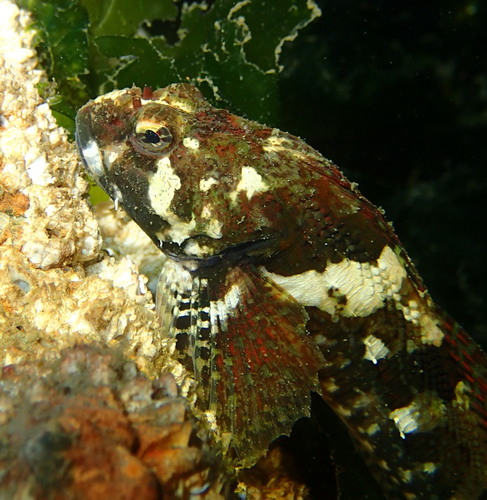
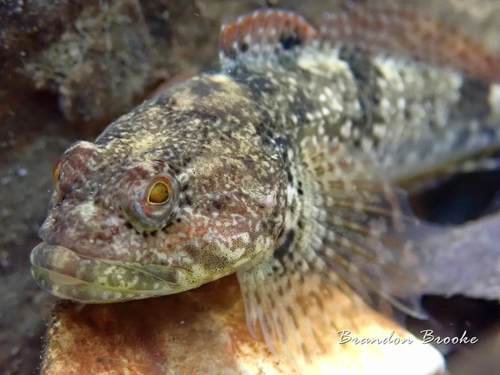
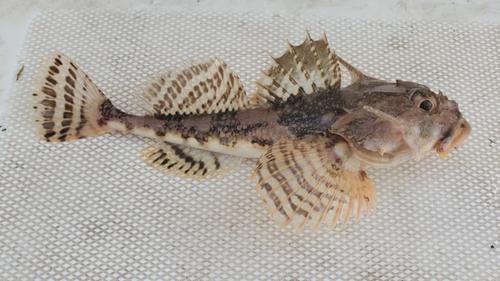
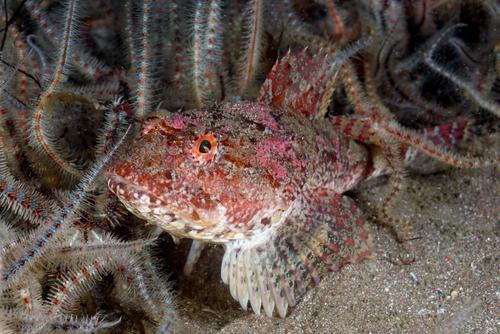
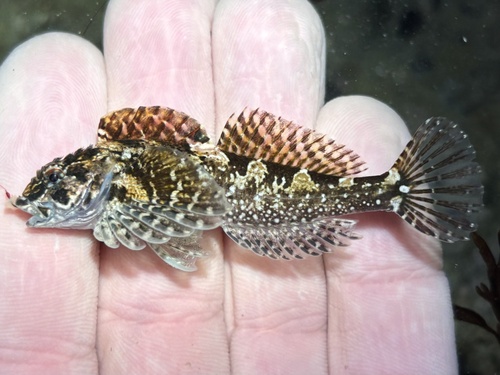
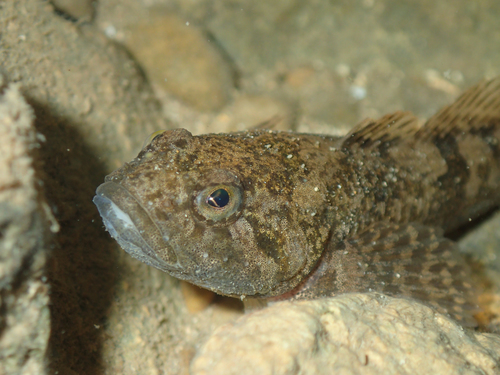
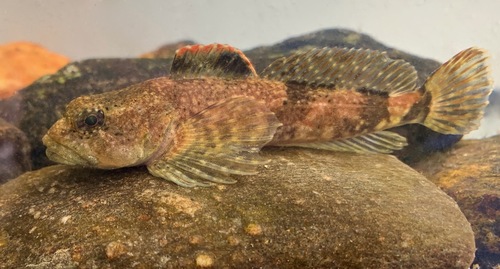
The mottled sculpin, Cottus bairdii, is a species of freshwater ray-finned fish in the Cottidae family, the typical sculpins. This species has a wide but scattered, discontinuous distribution across North America. As its common name suggests, its coloration consists of randomly distributed bars, spots, and speckles, and its large pectoral fins are banded. Its first dorsal fin is formed from slender, somewhat soft spines, and barely connects to the second dorsal fin. This species reaches a maximum total length of 15 cm. Mottled sculpins feed primarily on aquatic insect larvae, but will also consume crustaceans, small fish, fish eggs, and some plant material. One study recorded that bottom-dwelling aquatic insects make up 99.7% of this species' diet, with dipterous larvae and pupae the most common prey; the remaining 0.3% consists of snails, fingernail clams, water mites, sculpin eggs and fish. In turn, mottled sculpins are preyed on by other fish, most notably trout, with main predators including brook trout, brown trout, northern pike, and smallmouth bass. The preferred habitat of mottled sculpins is well-oxygenated, clear cool water, such as gravel riffles in mountain streams, springs, and along rocky lake shores. Females and immature individuals are most often found on clean water rock substrates, while males are most commonly found in algae beds. The mean current velocity where this species occurs is 0.28 m/s. It can tolerate warmer streams but does not prefer them, unlike Cottus girardi. Spawning occurs in early winter and late spring. During the breeding season, the male's head darkens, and he selects a protected nest site, such as under a rock or ledge. After courtship, the female enters the nest, turns upside down, and deposits her adhesive eggs on the ceiling of the nest site. Typically, multiple females will lay eggs in a single nest; the male then fertilizes the eggs, guards them, and fans the eggs with his pectoral fins. Mottled sculpins are cannibalistic: males will eat their own young if the young develop a virus or fungal infection, and males also eat small females, so older females are usually preferred as mates over younger individuals. While mottled sculpins have been recorded eating trout eggs, they are not a major threat to game fish. This species' main competitors are other small bottom-dwelling fish, especially other sculpin species, and all sculpin species are expected to coexist with members of the Salmonidae family. Geographically, the mottled sculpin's range extends from Labrador and Northern Canada south to the Mobile and Tennessee River drainage systems. It is widespread across this area from the Tennessee River north to Labrador, with separate isolated populations in the Missouri River, the Columbia River system in southern Canada, and the Bonneville system of the Great Basin. It is also common in Rocky Mountain streams and many streams throughout the Midwest United States. For the most part, the species' historical geographic range has not changed over time, as it is a resilient fish that can tolerate a wide temperature gradient. However, a 2007 study by Besser et al. found that mottled sculpins are now absent from some streams they once occupied, because the species is more sensitive to toxic levels of cadmium, copper, and zinc than salmonid species. Of these three metals, zinc appears to be the most threatening to mottled sculpins; one study ranked this species as the third most sensitive aquatic species to zinc. The greatest current threats to the mottled sculpin therefore come from habitats near heavy mining areas or regions where coal is burned frequently.