About Cotoneaster frigidus Wall.
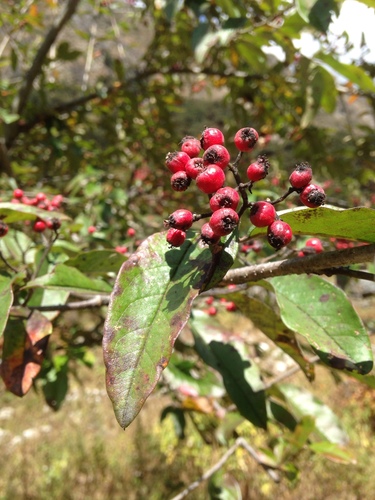
Cotoneaster frigidus, commonly called the tree cotoneaster, is a species of flowering plant in the genus Cotoneaster, family Rosaceae, native to the Himalayas. It is a deciduous tree or shrub that reaches 10–17 metres (33–56 ft) in height. It has smooth, matt alternate leaves that measure 6–12 cm long and 4–5 cm broad. Its creamy-white flowers are followed in autumn by large quantities of small, globose red pomes (fruit) 5 mm in diameter; these fruits persist into winter or longer if they are not eaten by birds. This species is widely cultivated in parks and gardens across temperate regions. Bird-dispersed seeds have led to it becoming commonly naturalised in Great Britain, and to a lesser degree in Ireland. It is one of the parent species of the very popular garden shrub Cotoneaster × watereri. Cotoneaster × watereri can be distinguished from Cotoneaster frigidus by its narrower, more lanceolate, slightly more glossy leaves that have slightly grooved leaf veins, all traits inherited from the hybrid's other parent, Cotoneaster salicifolius. The more compact cultivar 'Cornubia', which is also known by the synonym C. × watereri 'Cornubia', has received the Royal Horticultural Society's Award of Garden Merit. This cultivar grows to 6 metres (20 ft) in height.