About Cotinis nitida (Linnaeus, 1764)
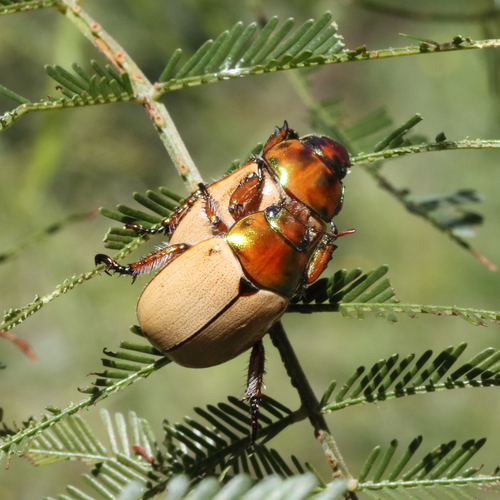
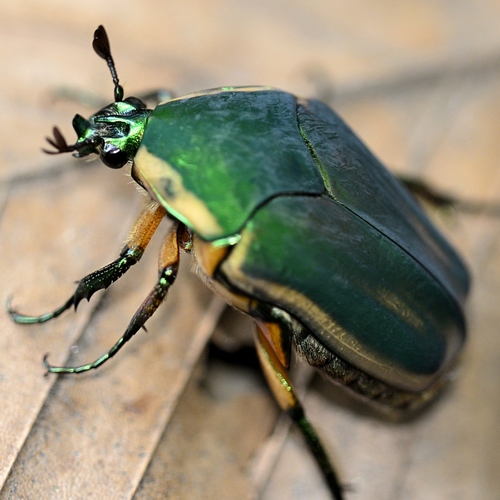
Cotinis nitida, commonly known as the green June beetle, belongs to the Scarabaeidae family. Its defining characteristics include modified forewings called sinuate elytra, and a prominent mesosternum. The scutellum is covered by the prothorax, which is attached to the base node. Males of the Cotinis genus can be distinguished by a small horn on the lower portion of the face, called the clypeus. This species differs from the common brown May or June beetle by its larger body size and vibrant coloration. Body color ranges from a brown beetle with green stripes to a fully velvet green body. The margins of the body are usually light brown or yellow, while the underside is metallic green or brown. Adult green June beetles typically measure between ¾ and 1.5 inches in length. Compared to common June beetles, this species has shorter legs and a stouter body. The geographic range of Cotinis nitida covers eastern United States and Canada, with the highest population abundance in the South. Its distribution extends from New Brunswick to Georgia, and west as far as California, where it may have overlapping populations with its western relative, the figeater beetle (Cotinis mutabilis). The green June beetle is a Nearctic beetle species, and is commonly found in New York, Florida, Nebraska, and Texas. Green June beetle larvae live underground in soil, while adults live on their host plants. This species can be found in lawns, fields, and forests, and occupies a wide range of habitats. Green June beetles are most common during warmer months, particularly June. They typically reproduce during summer, when warmer conditions produce the soil organic matter where females lay eggs, which newly hatched larvae feed on. Adult green June beetles are also common in spring, when host plants are actively growing. They are often seen in garden areas, where they feed on decomposing plant matter. They are more likely to occupy older fields than newly developed fields, because older fields contain higher amounts of organic matter. The green June beetle has a complete one-year life cycle.