About Cotinga ridgwayi Ridgway, 1887
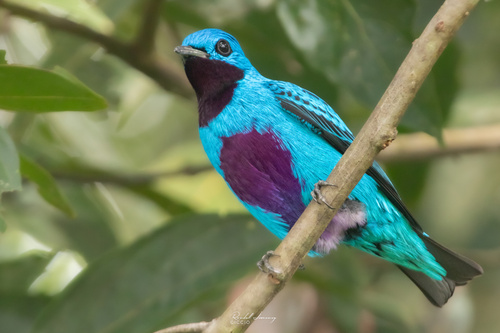
The turquoise cotinga (Cotinga ridgwayi) measures 17 to 18.5 cm (6.7 to 7.3 in) in length and weighs approximately 51 to 66 g (1.8 to 2.3 oz). The species shows dramatic sexual dimorphism, and adult females are larger than adult males. Adult males have deep turquoise-blue upperparts. Their wings are black, with thin to moderately wide blue edges on most feathers. Their tail is black, and their long turquoise-blue uppertail coverts cover much of the tail. A distinct patch of purple covers the male's chin and throat, and a separate purple patch covers the breast and upper belly. Adult females have mostly dark brown upperparts, with buffish white feather tips that create a scalloped appearance. Their wings are mostly dusky brown, with buffish white scallops on most coverts and cinnamon edges on the tertials. Their tail is dusky brown. Most of the female's underparts are pale buff with grayish brown spots, but their undertail coverts are unspotted. Both sexes have a dark brown iris, and dark gray to blackish legs and feet. They have a short, wide bill: the maxilla is black with a grayish base, and the mandible is gray with a black tip. Immature birds are similar in appearance to adult females, but have buff edges on their flight feathers. This species is distributed from the southern Gulf of Nicoya in west-central Costa Rica, south along the Pacific slope into western Chiriquí Province in far western Panama. It lives in the tropical zone, inhabiting the interior of humid evergreen forest and secondary woodland. In Panama, it occurs mostly below 900 m (3,000 ft), while in Costa Rica it can be found up to 1,800 m (5,900 ft).