About Cotinga amabilis Gould, 1857
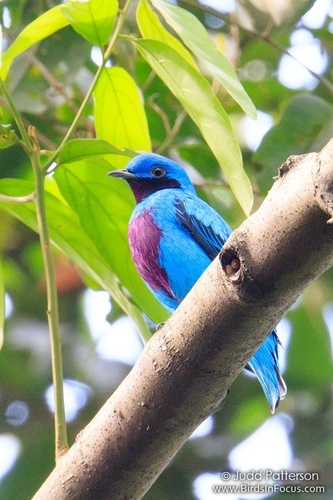
The lovely cotinga (Cotinga amabilis Gould, 1857) measures 18 to 20 cm (7.1 to 7.9 in) in length and weighs 66 to 75 g (2.3 to 2.6 oz). This species shows dramatic sexual dimorphism. Adult males have rich bright blue upperparts, with a slightly deeper blue shade on the crown. The lesser and median coverts of their wings match the bright blue of the upperparts. Their greater coverts, primaries, secondaries, and tertials are black, with blue or greenish blue edges. Their tail is black, with greenish blue or bluish green edges on the individual feathers; the uppertail coverts are long and cover the base of the tail. The lower part of the male's face is glossy purplish black, while the chin, throat, and upper breast are dark purple. The lower breast, flanks, and undertail coverts are the same rich bright blue as the upperparts, with the exception of an oval patch of rich purple on the belly. Adult females have mostly dark grayish brown upperparts, with whitish feather tips that create a scalloped pattern. Their wings are mostly dusky grayish brown, and the lesser and median coverts usually have a greenish tinge. Their greater coverts and flight feathers have pale grayish brown or buffy edges. Their tail is dusky grayish brown, with thin green or greenish gray edges on the feathers. Their underparts are mostly dull white, marked with dusky grayish brown spots that are heaviest on the breast and sides, and become less prominent on other parts of the underparts. Both sexes have a dark brown iris, a short, wide bill that ranges from gray to black, and gray to black legs and feet. Immature birds resemble adult females, but have cinnamon-buff edges on their wing feathers. The lovely cotinga is distributed from southern Mexico, starting in southern Veracruz and extending across northern Oaxaca and Chiapas south of the Yucatán Peninsula. Its range continues south along the Caribbean coast through southern Belize, northern Guatemala, and northern Honduras, and extends further inland along the Caribbean slope through Nicaragua and Costa Rica. There are also confirmed sight records of the species from Panama and the Pacific side of Costa Rica. It lives in the tropical zone, where it inhabits the interior and edges of lowland evergreen forest, and also occupies more open areas with scattered trees. In terms of elevation, it occurs from sea level up to 1,500 m (4,900 ft) in Mexico and northern Central America, and can reach up to 1,700 m (5,600 ft) in Costa Rica.